Dec 4, 2013

Talking the Walking (Dead)

I've been meaning to blog for a bit - not that there's been any shortage of topics, just that time itself has been a premium. NaNoWriMo was this month, and so was Movember - not that that required any time - if anything, not shaving every day is really helpful. I didn't finish my newest novel, but I am about 65k into it, so that's a big plus. In the press of the days, I managed to add that huge chunk of wordcount, plus I changed the book title (it's now called "Steel & Sky") and came up with a cover. I also finished the production of the Audiobook of "Reaper's Return" with Nigel Patterson, and that just went live yesterday. Also, in the middle of the month, I took an emergency train ride to Montana (don't worry, everybody's fine now) and even had some family come in for Thanksgiving. Also, in the mix were some dramatics involving the old house, so if you wouldn't mind crossing your collective virtual fingers for me, I'd kind of like that to be overwith too. One less rattle in the noggin would be a delightful bit of peacefulness.

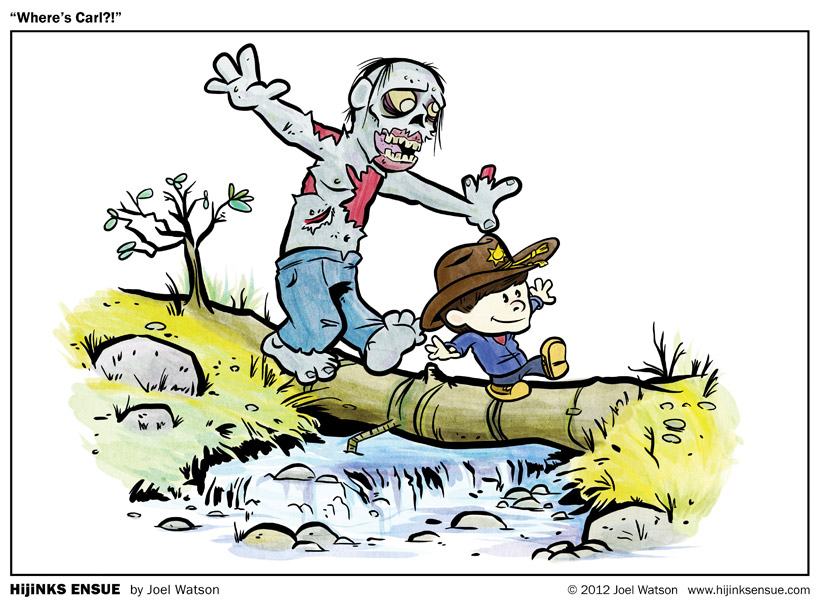
Also, November was a good month to wrap up a lot of television I was for some reason making time for. There are a couple of new shows - "Almost Human" and "Sleepy Hollow"; and it shocks me how much I'm enjoying those - and a few ongoing ones. Most notable were the Doctor Who 50th anniversary special, and, just this past week, the midseason finale of "The Walking Dead".
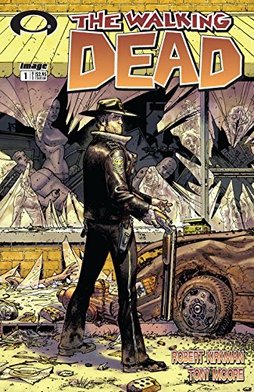
For those of you who may have been in a coma during the zombie apocalypse, this show (like the comic book it was based on) is about a fluctuating group of survivors following the pandemic infestation of a horrific and virulent disease. The world is now mostly populated by the undead, the flesh-eating mobile legions of zombies.

The creator, Robert Kirkman, wanted to do a comic book that took the concept of a zombie movie and kept going after the credits roll. He was constantly frustrated by the constraints of the zombie movies, because, as he explained it, "by the time you get to know these interesting characters, ROLL CREDITS."

The comic started about ten years ago, and picked up a huge fanbase and audience, and won several awards. Fact is, it's some pretty heady stuff. It strays from conventional comic book storytelling (in addition to nobody being superpowered, of course) and applies one major rule: anything bad can - and likely will - happen to the main characters. No spoilers, let's just say you really shouldn't get too attached to anybody.

This clever and inventive storytelling picked up such a tremendous following that it was only time before someone tried to make it into a movie. Projects specs were thrown unabashedly at Kirkman, who remarked that most of them read like bad zombie movies - one, I believe, had a talking dog - which was ironic, since that was exactly the very sort of thing his book was intended to combat.

And then, Frank Darabont approached Kirkman with a much better idea: a television show.

So far, with a few dips and wobbles, the show has been quite satisfying. But I think the part I find most interesting is to compare and contrast the story of the comic book with that of the television show.  Given my own projects, I find it interesting to see how storytelling becomes so dependent upon the medium.

I don't want to post details here - - some people are very anti-spoilers, and I'd like to respect that - - but the sort of things I find the most intriguing are the characters they use (and the ones they don't), the characters they kill (or maim, or leave pristine), and the individual stories they use, combine, change or leave out altogether.

See, some things just plain work better with whatever medium in which you're working. Look at fine art, for example. Recreating a beautiful sunset wouldn't work so well with sculpture, or pencil. You have to, to a certain degree, be willing to alter the original source in order to be best represented in the medium you've chosen. There are scenes in the comic book that just don't work as well on screen, so these have to be either adapted or abandoned. Comic books can be very limited because of their own, well, limitations. The Walking Dead comic book is all in black and white, for example, just like the old George Romero movies. AMC (the network that produces the Walking Dead TV show) even showed the first season in all black and white, as a kind of tribute marathon.

I stopped reading the comic when the show came out - I wanted to enjoy the show fresh, and not pick up any additional spoilers along the way - but I realized I was also now missing a lot of the "easter eggs" that the show runners were slipping into the series. So last night, I picked up my first three trade paperbacks and started them anew. It's been a few years since I'd read them, and I was pleasantly surprised at how well they held up as storytelling. I'd also been depressed at how much I'd forgotten about these early stories. Like, I'd forgotten all the character hookups, and how different these relationships had been there when compared to the show. That might sound like a silly thing to get hung up on, but here's the thing I think most people forget.

At its heart, this is NOT a zombie show. It's a people show. It's really all about how people react to the end of the world. Take out the zombies and replace them with nuclear fall out, or a forest fire, or boiling acid, or aliens, or rabid wolves. The story is about how people come to grips with sudden and permanent change.

Taken to its most personal level, think about the moment you realized that you were going to die. Like, specifically KNEW it. Everybody tends to have that moment, sooner or later, when you realize that the life you have had is gone, that you cannot in fact relive the past and that what lies ahead will never be like what has been. Sometimes, it's even more specific than that - you're diagnosed with something incurable, or lose a limb in an accident. Lose a friend. Lose a loved one. Admit to yourself that it's just never going to happen.

There is the old story about the man who was so wicked that the gods themselves conspired together to find an adequate way to punish him - and as a consequence of his deeds, they cursed him with the gift of prophecy. He laughed, recognizing that now he knew everything that would come to pass with a perfect clarity: he could see the future - not as it might be, but as it would be. "This is no punishment," he cackled, "this is a reward!" But then, he saw the moment of his own death, and, knowing that it was an unavoidable certainty, lived the rest of his life in abject misery. For to know one's end is a fixed point is to lose the most precious gift of all: hope.

One of the elements that is in the books but not so obvious in the television show is the eventual degradation
of hope. In the first few books, a common statement is said: "when things get back to normal". It's not clear when this reflex ends, but it does end eventually. Over time, it erodes to the point of ineffectiveness - it is too weak and frail a thing to stand up against the realization that things will, in fact, never be the same again, that the Time of the Walker is here to stay.

But in the television show, they are exploring different themes, in some cases much more subtle ones - - also, themes I believe the writers and producers now understand when looking back over the Walking Dead series as a whole which Kirkman could not have foreseen ten years ago.

Mostly, the one major theme the show is exploring is about what kind of person you become when faced with the end of the world. Where do your priorities fall, and what will you be willing to do to survive. It tries to address the question of "Hope versus Despair" in a unique way that the comic book is not always able to do. Granted, it has tools the comic book does not. It has an impressive and talented cast who can nuance an emotional response in a way that the comic book cannot; they have a soundtrack to help imbue the scenes with emotional subtext (not always effectively, but what are you gonna do), and it can pull focus to the exact place you need to go in order to get the story told to you in the way the writers and directors want you to see it.

The Walking Dead is a challenging concept to pace out, a complaint many fans have made. Consider this a moment. Once you've come to grips, as an individual, with the end of the world, what will then be required to change your perspective again? In that sort of an environment, how long does it take for habits to change, once newly established? Seems to me that you develop your "this is how we survive" habits, and everything else develops when you have time. You know, when you're not running for your life, or struggling to not die.

So when the different "chapters" of the show appear, they tend to advance the timeline by a few months, and we see all the characters adjusted to whatever new horrors they've faced, but they are established in those new (to us, at least) routines. And then, for several episodes, they don't really change so dramatically - or, if they do, it's only then at the end, when someone important to them dies. On the flip side, they can cram
enough intensity in ten minutes of screen time to fill up an entire graphic novel.

One last item, though. Characters on the show die. Again, I don't want to spoil anything, but, yes, main characters on the show die. They turn into zombies, are killed by friendly fire - sometimes not so friendly fire - and viewers get mad. It's an equation that can only lead to a sad and tragic end.

Coming from a writer's perspective, killing characters is NEVER an easy decision. You can't just kill them out of randomness, there has to be a point to their death - though, let's be honest, sometimes the point is to remind the reader that sometimes death is pretty pointless. A lot of folks will issue threats of "if you kill so-and-so, that's it, I'll never watch your show again!" which is both a compliment and an insult. As a writer, you want the people who read your material to love the characters so much that killing them will have an impact. But you also don't want people getting so mad at you for it that they stop trusting that the death MEANS SOMETHING.

George R R Martin lost me on a few of those deaths. He'd make me like a character only to kill them off by the end of that same introductory chapter. That makes me lose interest in even investing in future characters, period.

Joss Whedon ticked me off in the Serenity movie, too. Though I forgave him ultimately, there was a death or two which hurt. Like, almost tangibly caused me pain with their suddenness and brutality. As a fan, it stung. But as a writer? Man, I was impressed. The final act was filled with such juxtaposed hope and despair, that you truly just didn't know if they were going to come out on top in the end. You were anxious as they were, fearful that all their sacrifice would be for naught.

The difference between that movie and the Walking Dead, however...?

Serenity was a two hour movie, with a fixed resolution. The Big Damn Heroes would either triumph or die. No half-measures. But the survivors on the Walking Dead? What is their resolution? The truth is, they have none. Their success lies in survival, every week. If they survive, then they won the little victory. For their part, they have no choice but to try.

For me, the big question is whether or not the fans of the show will continue to manage their own sense of hope versus despair, and struggle each week with the characters, or if they, like so many of the characters so far, will simply succumb and be left behind.

Stay tuned.

Nov 11, 2013

Steampunk, Undefined

Had a wonderful time once again at this past month's SteamCon event in Seattle, Washington. The panels went nicely - mostly focusing on writing and self-publishing - got to spend time with some good friends and even made a goodly quantity of new ones. Scores as a win, I say.

Sometimes it's easy to forget, when you spend so much time in a particular genre - whether it be fiction, society, fandom, music or whatnot - about a few different perceptions that tend to go on. There is the perception among people outside of your genre about the people inside the genre, as well as the perceptions held by people inside the genre about others inside the genre as well as about those people outside the genre.

From the outside in, this generally gets expressed simply by one of two common questions I get asked:
"What's going on here?" and "What is Steampunk?"

The first question is mostly overheard at Steampunk events - I typically dress more or less how I normally do, plus or minus a vest or clever glasses, so innocent bystanders usually guess I'm a reliable source of insider information. They also guess that I'm not going to give them an answer in essay form (I leave that for the blogs).

But the second question I hear as often from people who know very little about Steampunk as I do from people who LOVE Steampunk.

Now, if you don't know much about Steampunk, it's a reasonable question to ask, right? (There was that episode of Castle where everyone was wearing top hats, right?) Any time a segment of subculture strikes popular attention - punk, goth, hipster, geek, whatever - there's naturally some curiosity about it. And that's a good thing. Steampunk isn't a religion or a cult, so nobody's looking to proselytize or corral in new members.

But it's when I hear it asked from other Steampunk fans that I grow concerned. Not because it's betraying some lack of Steampunkery or whatnot, but because oftentimes I smell a trap. Much in the same way the Comic Book fandom - and Geekdom in general - has been experiencing self-defining growing pains, Steampunk seems to be feeling the itch as well. But let's call it what it is: this is adolescence.

One of the primary characteristics of adolescence (which means, by the way, literally, "growing up") is self-definition. Figuring out who you are, and coming to grips with that. Self-confidence, self-identity, self-esteem. It's kind of self interested, really. And we find that same element in nearly every organization - it's been present in religions, political parties, and it's not by itself a bad thing. It's just a thing.

Now, granted, the roots of Steampunk have been around for years - you can effectively track it back to the Victorian era itself - but it's been reformed in the age of rebellion, of the redefinition of history, and it's been turned into a social structure, a fashion statement, a cultural resistance born straight out of the fires of DIY and a love of old world elegance.

When I wrote the Chronicles of Aesirium, I'll admit that my first goal was not to write a series of Steampunk books - the industrial age simply worked as the most ideal backdrop for the world I was creating, and it felt like the best place to insert my story. I wasn't trying to write the definitive Steampunk book - nor would I have ever wanted to. If anything, they're somewhere in the middle between "it has a gear on it" and "STEAMPUNK!", which is where I would generally want to be.

The new series - "Tales of the Dead Man" - is even less so. The first book, "Steel and Sky", involves two differing cultures, tech and natural magic. The tech world has a steam-powered science, but I wanted to take it out of pure victorianism and do something different with it. Also, I've written 6 borderline steampunk books, I wanted to introduce some new developmental elements into the new books - but the spirit of steampunk, as I see it, is still there.

And that's the part of Steampunk's adolescence that I enjoy so much. The elegant way in which we do it ourselves, embracing that most industrious spirit of adventure.


Oct 23, 2013

Archetype vs. Stereotype

I attended the recent Geek Girl Con in Seattle, this time taking my daughter as an excuse for enjoying a convention as an attendee (okay, she got some really cute moving cat ears that are both creepy and spectacular, and a reminder of why my daughter shall always be so much cooler than I will ever be. I cannot pull off the kitty ear thing, try as I may) - I go to so many conventions now for work that it's nice to just step back and remember why I go in the first place. It's officially getting to that point where I run into old friends and peers for the length of the floor, which I would qualify under the header "Problems I Always Wanted to Have." Day two was back to work - the other founders of Talaria Press and I gave a workshop on character creation, followed by a small signing, and it was one of the more cleanly inspiring hours I've had in a few months. Not to be underestimated. Aside from a few bad apples in the mix - there's always one or two, aren't there? - it was a solid and enjoyable weekend.

But now I'm looking down the barrel of another SteamCon, and before I get back into con prep mode, I wanted to wag my tongue about a topic that came up on the first day of GGC in a panel hosted by some of the directors of the EMP, along with writer Jane Espenson. The topic was about character archetypes, and much conversation was given to the evolution of the female archetypes over the years.


One question in particular took my notice: "What is the difference between an archetype and a stereotype?"

Everyone rattled off some answers and then they got side-tracked onto a different topic, as convention panels are wont to do. But the question hung over my head, and stayed with me long enough to, apparently, merit an entry on my blog, here.

The specific answers boiled down into the origins of the words themselves; into the marrow and substance, whereas "archetype" finds its roots in ancient Greek meaning "the original, best, or first, example." A stereotype is more of the "copy of a copy", wherein much detail is lost and the image resembles more like unto a caricature than a realistic image. Thus, a Hero would be represented by among the oldest and most established examples of such characters - Hercules, for example, as an archetype of the same; but those primary qualities of his, passed down through literature and the oral traditions of the time, still permit those heroic elements to carry forth in characters like Luke Skywalker and Superman. Eventually, those heroic elements become worn down and dulled, and the heroes become mere stereotypes of the ancient traditions.

Vladimir Propp whittled it all down into 7 broad character types - his "dramatis personae": the villain, the dispatcher, the helper, the princess (or prize), the donor, the hero, and the false hero. Jung broke it down into actual personality characteristics as archetypes for humanity - mother, father, child, devil, god, wise old man, wise old woman, the trickster, the hero, the shadow, the maiden, and so on. Even to a certain extent, tarot cards break down the types and facets of mankind through its use of imagery and metaphor in its major and minor arcana.

I'll confess, I've got a few of my favorites. I patterned my whole cast in the Reaper's Return series off various tarot cards, and shifted gears a bit in the latest series - everyone's going through at least two cards through the course of the books - but I do like to flip the cards over and see where they land, so to speak.

For example, the Tower card isn't so bad (author's note: okay, it looks pretty frightening in the deck, I admit). I used the tower metaphor frequently in the Reaper series. Rom's favorite place was a clock tower in the middle of Oldtown - and it's a statement about how she came to grips with the passage of time, of the evolution of life, and, specifically to her, how she as a Reaper had to manage life itself in a very tangible and literal way. In the tarot deck, it is a card to be taken quite seriously - a portent of dramatic change - but I wanted to write it into the books in a way of drawing back the fear and anxiety about change, and show that it's, like so much of life, something to be learned from and appreciated.


But what about you? What's your favorite archetype? What's your favorite stereotype - or your least favorite one that you feel could use a refreshing? I'd love to hear from you!

Sep 26, 2013

Dead Man (teaser)


Chapter One: The Pirate


The end of world came almost without warning.
No dark clouds, no ominous celestial portents of any kind. One day, the sun shone, the two moons continued their lazy chase across the Aerthian sky. The next moment, the sky parted and a great and glowing sword of light burst from the wound, striking Aerthos down and cutting a vicious swath of death through all its inhabitants. Man, woman and child, animal and vegetable fell before its dread blade, and when all had perished, even the Reapers stood for but a moment before they, too, were slain.
The world became like a lump of coal, blackened and dry. Cracks formed in the crust of the land, splitting the world wide to its core, until, at the last, every last ounce of life was sucked away to slake some bottomless thirst that lay beyond their perceptions.
Even the Reapers, the old woman thought with a shock that stirred her from her dream.  The most powerful beings in all of Aerthos, those who held the power of life and death in their hands, who could pass between the lands of Aerthos or through time itself as easily as a mortal could step from their beds. What manner of being has such power?
The screams of the dying were still fading in her ears as her eyes adjusted to the pre-dawn darkness. The winds toyed with the curtains of her room, blowing in from the east and the south. The same dream had first haunted her nights almost five years ago to the day, and she had not even the barest concept of what she could do to stop it. Surely the gods do not give us dreams of the morrow in order to punish us with fears of the unavoidable, she had thought.
As Song-Mistress of the Sky People, she had to be on the watch for dreams of grave portent. Sometimes the dreams were simple – go west for rain; watch the baker’s tower for an unexplained fire; treat the mason’s son with dried farol root and the extract of a spicy persimmon fruit to reduce his fever. For two incarnations of the Song-Mistress, there had been few concerns – the sandstorms which frequented the deserts notwithstanding – but now, this. She sighed ruefully.
A short-legged fur-covered animal appeared as if from thin air, its bright orange eyes sparkling in the half-light.
“Ah, Merlo,” the woman smiled. “Did I wake you with my dream?”
The creature shook its head. The old woman stroked the creature’s soft iridescent fur, causing her hand to momentarily look as if it was fading in and out of reality. In truth, it was a side effect of the creature’s natural camouflaging abilities, but Merlo had ways of using her fur’s shifting color patterns to achieve a variety of mystical effects as well.
The creature’s fur was the least of her uses to the old woman, however. As with all of her kind, Merlo was connected to all her species, living and dead. All memories and thoughts were stored in the aether of the world, floating in and out of their kind’s grasp. It made a fitting companion for a Song-Mistress – Merlo’s access to her species’ memories gave her a veritable library of history that stretched back thousands of years. Access to the whole of history helped put whatever visions the Song-Mistress might receive into proper context.
Sometimes, the best the creature offered was comfort. With the series of dreams like unto the one which had just awakened her, there was no context that helped, no historical anecdote that reassured the Song-Mistress. The dreams had troubled her and it had grown long since past the point where she had considered them a simple trick of anxiety or bad wine. What she had dreamed would come to pass, and though the final outcome was unclear, she knew that all life hung in the balance. She was old enough and wise enough to know that all too often the least desirable outcome stood the greater chance of happening.
But it was not until a month earlier that she had been given hope. Hope, strangely enough, that came in the form of a corpse.
She put what steps into motion as she was able, and now, with those steps already on another edge of the world, she was helpless to do aught but wait. Patience was not a lesson that had come easily to her. By the time she had a grasp of it, she had so precious little time left. One more irony to add to the pile, she mused. One more pinch of incense to add to the flames.
She exhaled, contemplating rising early to meditate in her prayer room. It was on the west of the city; it would still be in shadow for another two or three hours. She decided to stay here for now, and go to her prayer room when the sun was higher and that extra bit of cool would be most appreciated. For now, she decided to remain in the quiet shadow of her room, alone with her dark thoughts and the merest fragment of hope to drive them away.
“Fly well, my niece,” she whispered, flexing her old and tired fingers in an ancient gesture of good fortune. “Find what we so desperately need and return with it to us.”
Sleep would not return to her that morning. But all day long she would pause and look to the north, for sign of the airship’s return.


"Dead Man" is the new Aesirium novel by author Ren Cummins, due out by the end of 2013.

You can read more about his previous novels at http://talariapress.com/the-chronicles-of-aesirium/


Sep 18, 2013

The Other Half of my Blog Title

Okay, so for years now, I've been "Steampunk and Synthesizers", and I'm kind of shocked that nobody's called me out on only talking about Steampunk and writing. Honestly? Not one of you has wondered, "okay, Ren, we get it. You're a steampunk author. But what about...?"

So here we go.

Friend and fellow author (and the Jedi to my Sith), Kiri Callaghan, recently posted a few recent songs, and it inspired me to get off my butt and post some of my own material. I've had it up on Amazon as a CD and MP3s, but now that I've added some digital audio equipment to my office, I really am quickly running out of excuses.

So here you are. Music.

I included a "radio edit" I'd done for one of my longer songs, and included a song that wasn't even on my original album, "subterranean". We'd stumbled upon the idea for the song while we were doing some follow up work on a different project, and then I went back even later and did some remixing of it, adding some middle eastern percussion and samples to it, and made the song feel much warmer and earthier.

I've also plans to digitize my first album, which means I might finally get some uploads of a few of my all time favorite originals, "The Ballad of the Invisible Boy", and "Between the Mountains and the Sea." There's also a song I wrote with my old friend Storm Hodge, the U2-inspired "Homelands", which I honestly haven't even listened to in years. I'll keep you posted.

The summer's been a crazy one, my friends. We moved into a new house, are in the process of turning the old one into a sold one, and in spite of all that crazy, I've dug about 25000 words into "Dead Man", and started two other short projects, "World War Zero" and "Baktun" - two shorts for an end of the world anthology Talaria Press is doing.

AND.

I'll be appearing at Rose City Comic Con this weekend, at table J-01, with Kiri - and then I get to prep for two cons next month - Geek Girl Con and SteamCon V.

I need to hurry up and wrap "Dead Man", and then I've got to start working on "Dust" with Kiri, plus the follow up to "Apollo Rising" with Jen Ashton. How has my brain not fallen out? Hmm. It's a mystery.

Okay. Back to work.


Jun 27, 2013

Death Dealing

Death has always been a topic of some fascination for me, so I suppose it is no surprise that I devoted an entire series of books surrounding a character who literally becomes the face of Death itself. Recent events have brought this thought into sharper focus, however, and, not so much as a quest to express myself as a consideration to comprehend myself, I thought I should write something declarative about it.

I was pretty young when it first fell into my lap, this sense of mortality. My grandfather had already passed away before I was born, and my uncle died when I was around four years old. Family was a weird notion as well - I didn't know my father's side of the family quite as well even before my parents were divorced, and knew them all far less afterwards. So before I was even ten years old, I was left with the impression of having very few actual family members. And then my parents each remarried, and life was flooded with step-siblings and so forth. This probably should have left me feeling like I was blessed with an excess of family, but I think it sent me the other direction - feeling isolated and separated. I don't blame them for this - I can't think of an individual or collection of acts which gave me this impression. I interpreted my world in this manner, and I'm responsible for feeling how I felt.

My relationship to my parents started falling away in large chunks around this time. I know adolescence and teenagedom is generally given a lot of the credit for breaks in communication between children and their parents. There was a bit of that here, too, I suspect. But my mother and step-father moved to Missouri, taking a few of us kids along for the ride, so miscommunication or not, I became closer to my mother and more distant from my father. It was the miles, it was being a 16 year old boy, it was everything. Family members passed away. Grandparents - people I hadn't really known that well, given my age and distance - and others.

All the while, though, I was kept from what I would call a truer exposure to loss due to the comforting reassurance in the existence of heaven and the afterlife. "Families are forever", I was taught, and any natural compensation of mourning and grief was assauged by the sense that I did not need grieve, for my family would be reunited later in the presence of god. My tears - when they fell - were brief. Underneath them all, I doubted. Did I know? Did I believe? Was it really going to be the way I was taught?

I saw death, yes, but it was most prominent in how it affected others. My parents, my friends, my siblings. I saw the pain and grief in their eyes, and for the most part I felt a numbness - death was only a transition, I told myself. Life is eternal. There's nothing to cry about.

It wasn't until I was in my late twenties that I truly experienced death, in all its apparent finality and horror.

A few years earlier, I had at last confronted my struggle of faith and found that I couldn't follow the church of my youth - and that no church I could find really offered the path of faith I sought, if even any such existed. So, really, I suppose it was a fairly perfect time to have my world come crashing down.

When I was old enough, I had moved even further away from my family, resolved to figuring out the path to my life as only I felt I knew best. I've always been stubborn in that way - or maybe "stubborn" isn't the right word. I just didn't know if I could trust anyone else's opinion. I'd left everything else behind - my family, my home, my faith - and built a new life, one that was built on my own choices. I didn't know if I could trust my own decisions, but at least they were my own decisions. If I was wrong, at least I'd only have myself to blame.

I began to rediscover faith, growing out of my own experiences and awareness, made new friends, and met my wife-to-be and was eventually married. We rented a pretty horrible little house, but it was ours and we looked forward to taking on the world, just the two of us. And then, just a couple of months after our wedding, one of my best friends - and something of a surrogate father - died. He was in his early forties, and had been challenged by poor health for much of his life, but somehow I'd just never expected it to happen.

I saw his body at the funeral service, and it just didn't look like him. It was like they'd mocked up a "Mark suit" for the occasion, and had done a piss poor job of it, like some really bad special effects house or something. At the time, this translated to me as proof of the existence of a soul - for seeing such a potent difference between a living person and what remained... it was too stark to deny it. And I was mad at him. Jealous, to a certain extent, that he'd gone on ahead to discover that great mystery he and I had so often discussed, and that I was left with the great unanswerable question. I was pissed. I was afraid, but I was also pretty angry.

Anger and resentment gave way to something else. A year and a half later, my wife and I had a child, and the fascination with life brushed away the questions of death.

It is said that this is the one question which defines mortality - this is what has been the inception of religion, of myth and faith, since the beginning. When the sun sets, will it rise again? When the winter comes, will Spring return? When the seed is planted, will the flower bloom? That's the very nature of faith. What has come before may come again, but we don't know. We just do not know. What we can do, however, is believe.

With the arrival of our daughter, the question of faith has become a central topic for my wife and I. We both have distinct opinions on the matter - a fact I would have, once upon a time, felt to be uncompromisingly destructive to a marriage - but ones that, as it turns out, are oddly complimentary. In our case, however, I believe our differences stem from our exposure to death, when viewed through the lens of our sense of family. My wife has had a much different exposure to death than I have. It found its way straight into the heart of her close and loving family several years before we met. I'll never know what that's like, what that kind of pain and grief is like. I don't know that anyone could. No one should ever have to. Seeing the face of someone you love suffering like that, years later... it makes me hate death for the indiscriminate desolation it leaves in its wake. My wife was so close to her family, and suffered loss so suddenly and unexpectedly, and it seems like I just seem to have dodged grief this way and that, by having kept myself so far from the family I have known.

I know I can't run forever. Death will catch me again, either through me or through the people I know and love. I fear it, and I still hate it. I realize that Death is supposed to be a comforting angel, to greet us at the last moments of our lives, and take us to the verdant fields beyond, but I just don't know. In my books, I made Death into an eleven year old girl, vibrant and optimistic. In this fiction, Death is the opposite of my fears. She is a hero, filled with hope and flying above the rooftops. She is the protector of the people, clear-eyed guardian angel, terrible only to her enemies.

One of my uncles passed away this week - one of my father's brothers. I'm aware that my life is getting to that point where this is going to be more and more of an occurance as more and more people in my life will pass away. One day, I, too, will shuffle off this mortal coil, and I won't be around to come up with a clever blog to write about it. There's a finality in that which chills me.

And that's the danger, I think. Death has had an influence on me for much of my life, but not in the way with which I'm comfortable.  It's frightened me to the verge of inaction, terrified me into distancing myself from the people who I should have reached out to. It's stopped me from doing a lot of things, my fear of death.

The question I have now is, will awareness of this fear be enough to push me into a new path?

The truth is, I don't know. But something has to change. Because Death, whether a villain or a companion, is coming. Sooner or later, this whole living nonsense will be over. And I sincerely hope I waste no more moments of it while life is mine to experience.

May 13, 2013

The Choice Is Yours!

With the Steampunk vibe pounding once more in my veins, I'm ready - excited to start on my next adventure, but I find myself at a fork in the road.

There are two big stories I want to tell, and I'm not sure which one to do first. Here are the choices:

1. The big story of Grindel and Prama, the next two Reapers to arrive among the people of Aerthos; a dark new threat has emerged, and Romany has gone missing, and these two Sheharid Is'iin have not even awakened - will they be able to find Rom and save the world?

2. The further adventures of Favo Carr - the self-proclaimed hero of Aesirium and somewhat reformed scoundrel Favo has one great new adventure: to live.


Go here to my Facebook page and cast your vote - - I'll cap the votes on the 15th of May, and will begin working on the next book by the 21st.

Thank you so much! Allons-y!

May 10, 2013

Chronicles of Aesirium update!


It's a big day for mid-process project changes. I shall now gently put "The Old Bones" back onto the back burner while I make some big preparations for something potentially even bigger. I'm gonna need three/four artists, a videographer, a couple of actors, a musician/songwriter, a six pack of Mike's Hard Lemonade, a fantasy playlist for my iPod, and enough people to push a Kickstarter campaign all the way through to completion. And, of course, all of you, my friends - - - I can't do this without all of you.

"Do what?", you ask?

Why, how about a whole new Aesirium trilogy?

Yep, that's right. It  just hit me today, that while I'm very excited about the prospects of the Old Bones as a series, I'm really just not done with Rom and her friends, and their world of Aerthos. There are so many stories there, left untold. From the final (?) adventures of Favo Carr, to the new dramatic tales of Grindel and Prama, plus the lost legends of Force, Inertia, Artifice and Ian. Plus, there are more tales still, beyond and through the Blink, the old foundations of Aesirium, the Sky People, and more!

But first, there are more things even just associated with the stories of Rom herself, including an expansion of the world you already know. Maps and paintings of the characters themselves, including Mulligan, Rickets and Yu; an arcana of the main characters as Tarot cards - - you might have wanted an idea of what Cousins' deck looks like - - well, that's a new project I'm developing. I've also had a lot of requests for Mully, Yu and Rickets as plush animals; I'll be working on that soon, too.

All of this will be leading up to the next series, but I haven't decided yet which, exactly. Both stories are roughed out; look for a poll to hit my Facebook page soon - - make your wishes known, friends of Aesirium! The Favo Carr stories and the Grindel & Prama stories will all be coming out eventually, but whose do you want to see first? Ooooh, decisions, decisions!

Don't let it be said I am a cruel creator - - I want to give you what you want to read - at least, well, I'll let you choose from a small list, but that's something, isn't it?

Talk to you soon!

~ - ~ - ~


Ren Cummins is an author who currently lives in the Pacific Northwest. In addition to writing, he is an accomplished artist and musician, cat herder and professional nerdist. His second novel, "The Morrow Stone", was nominated for "Steampunk Book of the Year" in 2011. He is co-founder of Talaria Press, an independent publisher that focuses on alternate publishing models and low-overhead project management.

"Reaper's Return" is book one of a completed 7-book series of young adult steampunk fantasy tales, about Romany, an 11 year old orphan girl in Oldtown-Against-the-Wall, who discovers that sometimes, death is just the beginning of your life's adventure. It is a 65,000-word novel, written for ages 12 and up. All 6 novels and an additional anthology are available as both ebooks for Kindle and in paperback format through Amazon.

For more information about the books and the author, please see the author's website at www.talariapress.com

Apr 26, 2013

It's a good time to be a Nerd

2013 has a summer of crazy. Iron Man 3, Star Trek Into Darkness, Man of Steel, Epic, After Earth, Oblivion, Much Ado About Nothing, World War Z, Pacific Rim, RIPD, The Wolverine, Percy Jackson: Sea of Monsters, Kick-Ass 2, Elysium, The World's End... and that's just off the top of my head.

Frankly, I don't know that there's going to be anything left in my entertainment budget after this.

And then in the fall, there's Thor 2, Catching Fire, Ender's Game, Riddick, and on and on through the Hobbit, and, jeez, 2014 is already going to be insane. Clearly, Hollywood has realized that nerds have come into their own, have cash and aren't afraid to spend it.

Something to consider, going forward. Video games, comic books - the dungeons and dragons crowd has grown into its own target demographic. And to be honest, I kinda like it. Well, yes. Of course I'd like it. I'm right square in the middle of that group. The once too-geek-to-be-franchised is now The Franchise.

I'm kind of at a loss. After growing up feeling inclined to apologize for my geeky hobbies and interests, suddenly everyone seems to like it, but I can't shake the feeling that it's going to end up just like Carrie, where we're so overwhelmed by the sudden adoration that we don't notice the bucket of pig's blood that's about to come crashing down over our heads.

Which, as it turns out, has also been remade. Hrm.

Apr 18, 2013

#AtoZ Challenge Nominations for the Liebster Blogging Award


#AtoZChallenge Nominations for the Liebster Blogging Award

A-Z Blogging Challenge Topic: Nominations for the Liebster Blogging Award
I wanted to congratulate author Rinelle Grey for her Liebster Blogging Award nomination. The purpose of the Liebster Blogging Award is to give new bloggers a chance to gain new followers and to give more information to the blogger that nominated them.

Rules of the Liebster Blogging Award:
The nominees should do the following if they accept their nomination:
1) Thank the blogger that nominated you
2) Give 11 random facts about themselves
3) Answer 11 questions asked by the person who nominated you for the award
4) Nominate up to 11 bloggers with around 200 followers and post links to their blogs
5) Ask 11 questions that those nominated can answer
6) Post about the award and nomination on your blog and Social Media sites
7) Inform the selected nominees of their nomination

Thank you, Kiri Callaghan (+Kiri Callaghan ) of http://kiricallaghan.blogspot.com/ - The Geek Next Door for nom-nom-nominating me! You're magical!
 

Here are 11 Random Facts about Me:

1) I was alive (albeit only briefly) prior to the first moon landing.
2) I'm afraid of sharks in swimming pools. (borrowed from Kiri, because we inexplicably share this same fear)
3) my very first crush was on Wonder Woman (The Lynda Carter TV show)
4) I have recorded a full-length CD and have over 45 books published across more than 5 pen names.
5) I once played Shep Henderson in a production of Bell, Book and Candle.
6) I take a Sonic Screwdriver with me on nearly every trip, especially business related ones. (tenth Doctor, if you're curious.)
7) I have not yet learned to cook rice in a rice cooker. This is a personal concern of mine.
8) Until I was seven years old, I truly believed I might be able to become Spiderman when I grew up. I'm still not completely convinced that I can't.
9) I'm conversationally fluent in Spanish, but I'm getting a little bit rustier every day.
10) I will almost never refuse a slice of cheesecake.
11) My favorite smells are vanilla and cinnamon.
 
Here are the 11 questions to the nominees from the magical Kiri Callaghan:
 
1. Why is it you do what you do?
If you mean why I breathe, eat, drink and sleep, it is because it's a biological necessity and I have no choice but to do so else I will perish. If you mean why I write... its pretty much the same reason.
 
2. Something you hope to achieve in 2013?
I hope to complete two new novels, and at least one more anthology.
3. Something that haunts you.
Everything haunts me. If I did it, I wonder about what it would've been like had I not. If I didn't, I wonder what life would've been like if I had. Or if I'd done it differently. I wonder. All the time. Or, to paraphrase Shaw, I imagine the world as it might be, and wonder "why not?"
4. Something that always makes you smile.
Surprise hugs from old friends. Freshly baked cookies.
5. What you do when you're supposed to be doing something else.
I feel like I'm always supposed to be doing something else. I'm definitely more of a "path less traveled" kind of person.
6. Phrase you find yourself uttering consistently. (IE. I should be writing.)
"Internet service, why are you so slow?"
7. How do you get your muse going? (music, movies etc)
I use playlists on my iPad that are specifically designed to trigger the mood or theme of my current WIP; I only listen to these songs when I'm planning to write.
8. Biggest professional weakness.
I don't like to follow the established paths; I believe that just because this is how something has always been done doesn't mean it's the best way to do it. I believe that in order to be Beethoven, you have to think outside the Bachs. Sorry. That pun was unnecessary.
9. Biggest personal struggle.
Impatience.
10. If you could change one social norm, what would it be?
I would eradicate political correctness and shift the ownership of personal offense. I think people have forgotten that their way of seeing/perceiving/understanding/feeling a particular thing is not necessarily either the only way nor the right way.
11. I'll let the last one be easy: Your food/beverage of choice before/after/while you create!
Triple grande white chocolate mocha.

Blogs I nominate:
 
Steve Wilson - http://wilsongs.net/
Questions I have:
1. Star Wars or Star Trek or neither, and why?
2. Favorite Quote:
3. What was the moment or inspiration which told you what you'd want to do for the rest of your life?
4. Who is your favorite Doctor? (if you don't know what this means, then who is your favorite James Bond?)
5. What's your comfort food?
6. If money and social situations were no object, where would you want to go spend a week away from it all?
7. Who would you like to have play you in the movie of your life?
8. What do you do to decompress?
9. What is your Theme Song?
10. What is your personal motto?
11. What is one thing you do not yet know, but you wish to learn?
 
 
Go forth and do likewise!

Jan 31, 2013

It's A Cruel, Cruel, World

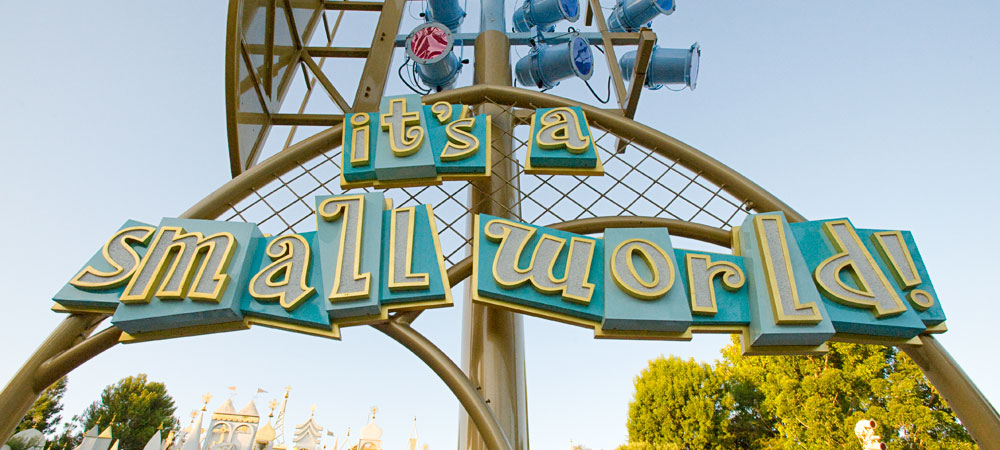
Just got back from a trip to Disneyland with the fam. We're a weird bunch, and as one might expect after a long day of rides, deliciousness and exhaustion, we get a bit...silly. The "It's A Small World" ride is down for annual maintenance, but that didn't stop us from ruminating on its general impact to our frequent Disney trips.

And then - as we so often do - we decided to give the song a makeover. Cummins family style.

This is what we came up with:


It's a cruel, cruel, world
It's world of drama, a world of pain
And a world of zombies who'll eat your brain
Though the earth must abide, it goes on when we've died
It's a cruel, cruel world
It's a world of scum and a world of crud
And there's probably vampires who vant your blood
Though its not a full moon, we must sing you this tune
It's a cruel, cruel, world
Chorus:
It's a cruel world after all
It's a cruel cruel world
It's a world of murder and of despair
There's a good chance that we'll lose all our hair
Though we still have the sun, it might fry everyone
It's a cruel, cruel, world
It's a world of business with no good sense
It's a world with no grass on both sides of the fence
Though between you and me on this thing we'll agree
It's a cruel, cruel world
(Repeat chorus)
It's a world of terror without any fear
It's a world of anger, a world of fear
Though I'm not naming names, they'll all go down in flames
It's a cruel, cruel world
It's a world of bigots, a world of dumb
As the rest of us all gradually grow numb
Thus we all do decline til the end of all time
It's a cruel, cruel, world

Jan 21, 2013

The Platinum Rule

Just wanted to drop out a short comment or two about a clever concept I heard the other day - about upgrading the notion of the Golden Rule (for those who never went to sunday school, it's the "Do Unto Others As You Would Have Them Do Unto You" one) to a Platinum Rule "Treat Others The Way They Would Like To Be Treated."

It's a subtle difference, between treating them as you'd like to be treated and how they'd like to be treated, and puts the onus of interpersonal comprehension squarely on our own shoulders.

Here's an example:

When I'm writing, I like to be left alone. Pretty much functional if not one single person interrupts my flow, and, barring aforementioned interruptions, I can spend a qualified successful day just on my lonesome, working on whatever project may have happened across my scope.

However, even though my lovely and loving wife fully supports my writing processes, she's much happier if I take some time out to, say, make lunch for everyone, walk the dogs, or do a brief spot of cleaning. Even though simply being allowed to focus on writing (also referred to as "buying my wife a swimming pool") is the way I would like to be treated, I can't do the same reflectively - - that leads to unhappiness, and as any married person will tell you, if your spouse is unhappy, you are unhappy. You just don't know it yet.

Thus, to have a truly successful writing day, I can't simply treat my family the way I want to be treated, I have to treat them the way THEY want to be treated. Then, as it turns out, they leave me as much time as I need to write, and in the end we're all happy.

Anyway, there you have it. The Platinum Rule. We'll now return to your browsing of cute cat memes and debates about American politics, already in progress.

Jan 7, 2013

Life Skills

Found this great article over on the Huffington Post, and wanted to save some of it here, mostly just so I'd have a place to refresh my brain in case they archive the page there.

It's about life skills that simply must be mastered - they say "before the age of 40", but I don't believe it's ever too late to start learning new tricks. So here are a few of my favorites:


How To Spot A Good Opportunity
"A lot of people ask me how I knew 'Mad Men' or 'Breaking Bad' would make great TV. I knew because when I read those scripts, I felt something. I didn't do any market testing or focus groups -- I just asked myself, 'Would I want to watch this?' When you're weighing an opportunity, make the question that simple: 'Do I really want this, or am I doing it for the money or the prestige or because I think I should?' It can't just be about those things. It has to make you feel good, too. And by the way, if opportunities aren't knocking, you can make your own. When I was looking for work several years ago, I took everyone I knew in New York, where I'd just moved, to dinner or drinks or tea. I explained that I was open to anything. Six months later, one of those dinner dates called about a possible job at AMC. If I hadn't put myself out there, that never would have happened."
-- Christina Wayne former senior VP at AMC, current president of Cineflix Studios, and an executive producer of the new BBC America series "Copper"


How To Not Sweat The Small Stuff
"The thing that's grand about spending your time thinking about the universe is that it makes you feel insignificant. I don't mean that in a bad way. If you understand that we've now discovered entire solar systems that contain planets similar to Earth -- and that those are just the ones we know about, since most of the stars we've looked at are within about 300 light-years of Earth and the distance to the center of our galaxy is nearly 100 times that -- then you realize that the laundry you've left undone and the dumb thing you said yesterday are about as significant as slime mold."
-- Alyssa Goodman, professor of astronomy, Harvard-Smithsonian Center for Astrophysics


How To Let Go Of Anger
"Anger is like a storm rising up from the bottom of your consciousness. When you feel it coming, turn your focus to your breath. Breathe in deeply to bring your mind home to your body. Then look at, or think of, the person triggering this emotion: With mindfulness, you can see that she is unhappy, that she is suffering. You can see her wrong perceptions. You can see that she is not beautiful when she says things that are unkind. You can also see that you don't want to be like her. You'll feel motivated by a desire to say or do something nice -- to help the other person suffer less. This means compassionate energy has been born in your heart. And when compassion appears, anger is deleted."
-- Thich Nhat Hanh, Buddhist monk and author of Anger: Wisdom for Cooling the Flames


How To Buy Great Wine

  • "See if an expensive wine's producer also makes a value bottle -- it's likely to be crafted with the same care.

  • Serve wine with food from its region. For pasta, look to an Italian bottle. For paella, go Spanish.

  • If all else fails, try Malbec from Argentina, Merlot from France, Pinot Grigio from Northern Italy, and Chardonnay from Australia. Pinot Noir pairs with almost anything. And you can't go wrong with bubbly."
-- Sheri Sauter Morano, Institute of Masters of Wine


How To Know When To Quit
"After my first book was published in 2000, I spent two and a half years writing a novel. But it never felt right. I didn't even name it -- it was the poor, misshapen beast child I kept hidden under my bed. Then I showed it to my agent. 'None of the things you do well are in evidence here,' she said. I was devastated, then relieved: I had failed, and now I could stop. If you don't feel a shiver of excitement or fear, if there's no emotional risk involved, let it go. You can't discount how hard it will be to leave your bad marriage or stop writing your bad book, but if you're unhappy, nothing can get better as long as the status quo stays the status quo."
-- Elissa Schappell, author of Blueprints for Building Better Girls


How To Listen Better
"Start by doing everything you can to fire up the 'mirror neurons' in your brain, which mimic what others are experiencing. You can subtly imitate the other person's posture, even match the pace and depth of their breathing. Your words can also mirror what the other person is telling you. For example, you might say, 'What I'm hearing is that it distresses you when your husband wears his tiara in public' or 'Wow, I can tell just from your voice that you're under serious pressure.' Don't add advice or commentary -- just reflect. If you simply must add something, ask the speaker to disconfirm what you say. In other words, ask to be told where you're mistaken -- and mean it. 'I'm thinking it's not so much that you're embarrassed as that you want a tiara of your own -- am I wrong about that?' Do not ask to be told that you're right; it turns a listening ear into a bid for authority, and no one will want to talk to you then."
-- Martha Beck, O's resident life coach and author of Finding Your Way in a Wild New World

Dec 14, 2012

Mad World

I just can't get my mind into a proper headspace to write fiction today. The non-fiction in the world seems hell bent on spearing itself through my waking thoughts, and it's simply too much noise for me to reach a calm balance and steer through to create. President Obama just talked publicly about the shooting in a Connecticut elementary school; the flags are being lowered to half mast. A lot of people have taken to having a moment of silence for the lives impacted by this event, which is a good idea. It's the bit where we all start talking again afterwards that has me curious.

Two mass public shootings in the past few days, this one at an elementary school. I'm.... I don't quite know what to say about this. It's a terrible thing, not only in the immediate tragedy of the moment and with respect to the lives that were lost, but also at watching the chaos that ensues among those of us forced to stand in observation of it, and being left to wonder not just what was it that led to this horror but in trying to discover a plan to prevent it from happening again.

I have a child who's in elementary school. This whole thing just flares into my mind in a truly real "what if" capacity, and it's a struggle to keep my emotions from blinding me to pure and undiluted rage.

The conversation at present, unfortunately is devolving into the same one that always happens after these events. The fact that it's happening so often now makes me worried that at some point CNN or Fox or whoever will just end up having a daily "Today's Massacres" update. It doesn't feel like we're far off from that now.

Many people are drawing this whole event into a chance to discuss gun control laws, or, on the other side, a chance to point out that a person did this, not a gun. As with most public debates, I find that both sides are right. A person walked into an elementary school and shot some two dozen people.... WITH A GUN.

I'm forecasting that they'll find the shooter to have had no previous criminal record, making this act his only actual crime, other than perhaps having the guns in the first place. Gun control opposition will use this to reinforce their stand that gun control laws only ensure that nobody has a gun except for the criminals. Although the opposite is also true - having no gun control laws just mean that anyone can have a gun, even those people who haven't committed any crimes YET.

Gun Control laws or not.... this won't change a thing. Take all guns away - if such a thing were even possible - and you'll see people walking into schools with a baseball bat or a bow and arrows, or maybe just driving down the halls at full speed in their honda prelude. The weapon is the facilitation of the crime - so there's something to be said for taking away or controlling those weapons that allow a person to take even more human lives so easily. For that matter, I wouldn't mind there being better driving laws, too, and do what they can to keep reckless drivers off the road. But regardless, this doesn't fix the actual problem.

The problem is that for whatever reason, there are people who think it perfectly allowable to walk up and kill people. Oh, I know, some people think homosexuality is the big evil - or drug use, or Dungeons and Dragons, or heavy metal or rap. But the real truth - the thing we're not looking at - is that we are forgetting about the value of a human life. I'm not making an arguement for or against abortion, here, either. What I mean is that a life should matter. Your life matters. Other people's lives matter. Life. Matters.

A thought crossed my mind earlier, almost flippantly, about how all these people who shoot at dozens of random strangers then turn the gun on themselves, tidily wrapping up the entire event into the title of "murder/suicide", and why these people should stop being so cowardly and START with the suicides. I mean, lower headcount, and in the end, as far as they know, they got the same basic result, right?

But the deeper I thought about that, the more I realized that even the shooter's life matters. They may not agree - - they clearly disagree to such an extent that they want to go out with a series of big bangs - but what if they had made a different choice? What if, instead of killing all those people, they had written them all anonymous Christmas cards? What if they had made it to the news by walking into the school, randomly hugging all the school administrators, left a box of oreos on the table and then gone home to play "Simpsons: Tapped Out" on their iPads?

Dude, I never knew who you were, but...well, going by the odds, there are some dozen people right now in this country who are considering doing what you did today. We don't know who they are, we don't know why they're doing it. We can't imagine their resolve, and may not even remotely imagine them capable of doing something so horrible. To a certain extent, maybe you can't either.

But here's the thing: we would infinitely prefer that you didn't. You have a chance to make an impact for good, regardless of what you might think. Killing other people, killing yourself... those aren't your only options. Especially taking someone else's life. It's not yours, you don't have that right to it, you just don't.

Death is not the only option. And, among all the options out there, it's rarely very high off the bottom of the list. Certainly, it's never the best option.

Please, from one human being to another, I'm begging you. Put the gun away. Step away from this sense of pre-destined entropy and remember that these lives are not yours to take. You can't have them. And if all your thoughts revolve around dreams and fantasies of murder and violence, please get help. It's okay to get help, you know? You don't have to deal with this.

In fact, none of us have to. Regardless of our differences, we're one big group of people, one giant community, one breathing and living organism of the human condition.

Let's be better than this, everyone. Let's move forward. Let's go.

Dec 12, 2012

Remember This.

Been an interesting year. Winding down, now, into the last 2+ weeks of 2012, and as I just cannot seem to keep from doing, I am tripping over my tendency to pause and look back over the year.

It's been a plus and minus year - advances in publishing and writing, as well as advances in discovering the limitations of my own awareness and ability. It's been a climb, that's to be certain, but nothing ventured, nothing pained.

It's a year, that's all. Just like the Mayan calendar, they are less like fixed points and more like mile markers. Except they tell you how far you've come, not how far you've yet to travel.

So let me wrap this year up with a revelation: Dare. When you're out in the middle on uncharted waters, and mucking about in the center of an unexplored forest, it doesn't mean you're hopelessly wrong or abandoned.

Remember this:
  • Not all who wander are lost.
  • Flying comes from falling.
  • Making no choice at all is still a choice.
  • Following in the path of others is neither innovation nor invention.
  • When you're doing something that's never been done before, you're doing something that's never been done before.
Here comes 2013. Make it count, buster.


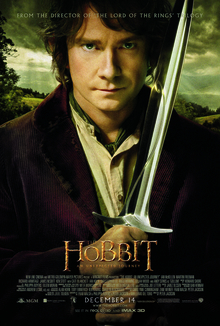
Twas the Night Before the Hobbit

Twas the Night before Hobbit


Twas the night before Hobbit, and all through my home
Not a goblin was stirring, not even a gnome
The blu rays were placed by the TV in stacks
With the extended versions and CD soundtracks.

We’d all gone to sleep, more or less, and we dreamed
Of what we would soon be enjoying on screen
Thanks to Phillippa Boyens and Pete Jackson, too
Fran Walsh, Howard Shore and the cast and the crew.

When up on the roof there arose such a noise
Like the dogs had knocked over my collectible toys
So I sprang from the bed and ran to the door
And I grabbed Glamdring so I could give them what for

The moon in the sky seemed to shine with a flame
Like it was echoing fire up from old what’s-his-name
But I could see well enough to perceive in the night
At the end of a long staff, a twinkling light

Held aloft by an old wizard, grey was his cloak
And around him a gang of fourteen smallish folk
There was one who was smaller by far than the rest
Who was quaint, somewhat humble and casually dressed

While the other thirteen all bore armor and swords
And the wizard looked ruffled and angrily swore
“Now Thorin and Balin and Bombur and Dori!
And Bifur and Bofur and Ori and Nori!

On Oin and Gloin and I see you there, Fili,
Please stay with the rest, you two, Bombur and Kili!”
And he said to the Hobbit who stood by his side,
“Master Baggins, I don’t think that you'll need to hide.”

To the fellowship, he indicated to stay
While he had “just one errand, one part left to play.”
And he vanished right then from the top of my roof
Without any outrageous display, not one poof

But I heard him just then somewhere inside the house
And I climbed the stairs quietly, just like a mouse
So I caught a fair glimpse of that wizardly gent
As he took it all in and saw how much I’d spent

On the books and the videos, (also the games)
The art books and novels, each thing bearing the name
Christened them by their maker, of Tolkien himself
Who’d written these tales of man and of elf

Good John Ronald Reuel, who’d penned them all down
And whose visions live on in the lights and the sounds
For a new generation to have and to hold
And to let inspiration make new tales to be told

As I stood there and thought of the marvelous fables
Old Gandalf the Grey took one look at the table
Where three tickets were placed for the matinee show
So that after elevensies, we could then go

To that movie which we’d been excited to see
About Gandalf and Bilbo and the Dwarven thirteen
Would we get to see Gollum? Oh, yes, this I am clear
But I doubt we’ll see Smaug for at least one more year

Til in twenty thirteen we’ll have the Hobbit, part 2
But then only one more and the movies are through!
This sad thought occurred to me - briefly just then
But before I could go there, or come back again

I discovered that Gandalf was looking at me
And I thought very much that I wanted to flee
But he shook his head no, with his pipe in his teeth
And blew out a small cloud in the shape of a wreath.

He looked tired and thirsty, leaned on his staff
But I held out a chair and he started to laugh
I offered him a drink, but he passed all the same,
“We’ve miles to go, and I must not delay,

But we wanted to thank you, and all of the fans
Who have watched us and read us every woman and man
From the oldest to youngest, every parent and child
Who have walked on beside us for all the miles.

We will share these adventures, they’ll never be gone
For this road that we travel, it goes ever on.”
And he said all these things and gave me a stare
But then, suddenly he vanished into thin air

And I heard high above, back outside in the night
With a voice that could give even dark riders fright
“Let us go, Master Hobbit,” and “Let’s ride,” to the rest
“Many miles to go, put our feet to the test!”

And away they all ran, cross the wintry sky
Even Bilbo, who looked like he wanted to cry
But he turned at the last, sharing this wish with me,
“Go on, see the Hobbit, parts one, two and three!”


- Ren Cummins (with thanks and apologies to the aforementioned Misters Tolkien, Jackson and also Clement Clarke Moore)