Show of hands, how many of you are exhaustingly familiar with that old chestnut about the teacher who asks their troublemaker student the difference between Ignorance and Apathy, to which he responds, "I don't know and I don't care."
I still like that joke, with an affection generally reserved for someone else's mad relatives. I enjoy it like you enjoy a new dish, an unexpected sunset, making comfortable eye contact with a complete stranger. I really shouldn't like that joke so much as I do, but I do and what are you gonna do about it?
I suppose the bit that appeals to me is the simple elegance of it, superimposed with the subtextual warning against confusing those two mental/emotional/sociological states of being. If we are ignorant, let us be made aware; if we are apathetic, let us give a damn. Now that's a prayer I could get behind. But, in all seriousness, how?
Ignorance is one thing - the sum of "all that which we do not know that we do not know" is a broad and pervasive challenge to our intellectual progress, countered often by the simple admission that it exists at all. I've definitely been burned many a time by feeling too comfortable in my own intelligence, only to be hoisted by the petard of knowledge I might have otherwise owned had I simply sought it out. I was told as a youngster that it is better to be thought a fool in silence than to open your mouth and remove all doubt. And when I say I was told that, it is accurate. To have been taught that, however...well, clearly I'm not referring to myself. I'm fairly sure I've "removed all doubt" often enough to make that point fairly clear.
But Apathy is a more ferocious beastie. How do we care? How do we keep caring? How do we manage to continue giving the proverbial damn in light of a lot of people whose every act seems (note: SEEMS) intended to crush will and hope and aspiration? Apathy just as a passive response to things which exist well outside our own experience or social structure - for example, do I deeply care about the planetary classification of Pluto? Well, not really, no. I'm curious about it, but I'm not losing sleep over it.
Okay, so now I've jumped deeply into the middle of a conversation without referencing the inspiration for it. Allow me, please, to correct that.
Being a writer - or musician, or actor, or...well, honestly, being ANYTHING - tends to put you out there into one spotlight or another. Some occupations, clearly, are more obscured than others, but generally taking a step up any ladder that rises ahead of you sets you up to be viewed, reviewed and critiqued by the others standing around the same ladder. This becomes an opportunity to confront the aspect of personal, creative apathy that confounds so many artists. Or to put it another way, ask any "aspiring" artist why they've not yet put their work out for public consumption.
Back in the period of my life where I was focused on music, I wrestled with putting my music out there. Oh, I wanted it out there, yes. I performed live, I recorded demos and final projects, and, in the end, sweated over it every time someone heard my music. I frequently equate it to the idea of showing up naked to your first date. "Well, whattaya think?"
That intense level of stress I felt is partly why it was so easy to drop music as a perceived choice for a career. Basically, no job should be so anxiety-inducing that you're an absolute wreck. If you're taking anti-psychotics as a means of divesting yourself from worrying too intensely about whether or not you're doing a good enough job, take a step back, for your own good.
As an author, I haven't felt the same level of stress. It's remarkably different, in fact. Happy to have people read my books, and I'm generally unapologetic about them investing the time into reading them. Not that I think it's going to solve world peace or world hunger or cure cancer or anything - they're stories, plain and simple. Did I love writing them? Yes. Do I love the characters and places? Yes. Do I assume it's everybody's cup of tea? Well, I don't make that assumption of any book, though I do think mine are pretty generally accessible. This isn't ignorance - - I think the more dangerous assumption would be that everyone would love it.
Important rule about creating your work: if you try to make something that everyone will love, more likely as not NOBODY will love it.
I've done writing that wasn't borne out of an impassioned drive to craft a tale - technical writing, informal proofs, FAQs and the like - but I personally believe that it's important to care about whatever it is you're writing - it's critical that you give a shit. You have to care, you have to want to do it, and you have to allow that Want to impel you forward. Otherwise... well, it's just blah. It's just devoid of humanity, it's lights and tinkling brass, form but devoid of soul. Like, really bad fast food or something.
Essentially, you kind of have to give a shit. And you should probably WANT to give a shit, if you're considering doing something artistic for a living. Because it's not easy. You have to want it. You have to fight for it - fight against your self-doubt, your uncertainty, and so forth. There will be times where the only reason you do it is because of your will to do it. No one is going to hold your hand, you won't get pep rallies, and if you've already got a fan club, well, then you're pretty much ahead of the curve.
See, most artistic endeavors are found on the roads less traveled; some of them aren't even roads at all. There's no really clear and defined path for becoming successful. There's no guarantee you're going to be successful, there's a chance that it may just not be an artistic expression that has enough of a broad appeal to generate the kind of revenue you may have in mind. To this extent, you have to not give a shit.
So, I guess that means you can give one shit, but not two?
Okay, now I'm just being ridiculous.
Sep 25, 2012

Aug 28, 2012
The Odd Insecurity of Tradition
It's strange, the things that randomly occur to you when you step out of the middle of an emotional conflict. For going on [redacted] years now of actively engaging in the delightful melee of publishing (I won't whip out my literary measuring stick, such activities seem so very pointless, don't they?), I've watched as the social tides of verbal battery have shifted thither and yon, with neither side giving - or gaining - much ground.
That is, if you analyze simply the intangible outcome of their philosophical campaigns. The reality - as it so often proves to be - is another tale altogether.
I've watched as industry insiders flocked to Amazon and left the occasional 1 star review with the critical comments: "Would've enjoyed this book more if it had only had a good editor. This is why I don't like picking up self-published books." Honestly. They really ought to figure out a better approach - if only they had access to people who could write creatively! But nevertheless, their efforts to corral all self-published authors into the descriptive of "young, brash, impatient writers who just need to learn a thing or two about the industry they claim to love so well" has done little to diminish the ground gained by self published authors. The number of authors successfully making a business of their efforts is increasing steadily, in spite of the general cursings from industry traditionalists.
At the same time, I've seen many attempts to demonize the mainstream old schoolers, with implications of finance over substance, heartless, cold wretches of kings choking on the crusts left by their once invulnerable processes of alchemical transformations. And to a certain degree, they've done precious little to prove these accusations false. Attempts to define themselves as Cultural Gatekeepers and Protectors of Artistic Purity don't do much to endear themselves to their reader base. Nor, truth be told, to their author base.
The criticisms of one group by the other have only escalated - the internet and ebooks have simplified the publishing process, and the economy has both given encouragement to writers to write as it has urged editors to edit, and artists to... well... do that art stuff. Possibility has met with desire to create spectacular work, and the efficiency of delivery has placed millions of books into the hands of a generous public.
Has traditional publishing been challenged by this? Well, yes. Of course it has. There a millions of new books out in the market, giving readers millions of new choices, and, yes, that means the "TradPub" industry has to now share the stage with thousands of independent publishers and previously unknown authors. For a previously struggling industry, this can only make their blood run cold. And what are they willing to do to keep their hands on the money coming in.... well, what wouldn't they be willing to do? People are dependent upon that revenue - distribution agreements, printing contracts, marketing, and on and on. It's a whole web of interacting money changing hands, and now, not only are they not making the money they once did, now they're losing more because so many new authors are getting in the way of them and their money.
Really now! The nerve of those independent authors!
 So, they're scared. They're a big, bloaty wildebeest, trying to figure out why it's so hot on the savanna. A little twitchy, a little malnourished, and that oasis is looking a bit more like a mirage with every passing minute. Ooh, that piece of grass moved a little bit. Is that a lion? Oh my god, it's a Lion! AND IT'S GONNA EAT ME! RUN!! RUN!! STAMPEEEEDDDEEEE!!! Oh. Oh, wait, no. No, that was just a piece of grass. Stupid grass. I'd eat you but you're really dry and I'm really thirsty. But this grass over here likes me. It wouldn't tease me by making me think it's a lion and freak me out so bad that I'd start a stampede and run over my best friend Terrence. (yes. Terrence the Wildebeest. Back off, dude.) See? You're much nicer grass. You look kind of tasty. Especially that bit near the bottom that looks like round, deep pools of amber, resting atop a row of sharp, glistening teeth OH MY GOD YOU'RE REALLY A LION AND NOW YOU HAVE ME BY THE THROAT AND I'M ONE DEAD WILDEBEEST DAMN IT...OH THE HUGE MANATEE... [dies]
Okay, Mutual of Omaha time is past, let's move on.
So, everyone's on edge. The American economy has as many issues as Sports Illustrated (sans Swimsuit Issue) and people are acting a bit like those drowny folks at the end of Titanic, thus it's a wee bit scary. Much nicer over here, watching from a safe distance. Just lots of well-dressed folks splashing about, trying to find a bit of flotsam to cling to, while the cold water slowly drives the warmth from their bones.
(Jeez, Ren, way to put a positive spin on that analogy.)
Okay, so here's a nicer uptick to wrap things up. Look, everyone, it's a really big industry. A lot of people are remembering - or discovering - how much they love books. A lot of people don't. Sales overall will continue - or may continue - to climb, but there are both new authors and new readers, so the gains may be only marginal. There are the added distractions and storytelling constructs of Supercable TV, the Internet, Video Games... so either the Gatekeepers of Creative Traditionalism and the Revolutionaries of the New Literary Frontier can find a way to work together, or they will continue to find new and delightful ways to tear one another apart, leaving only the most stubborn and flexible ones surviving.
You think it's going to end up another way? Then clearly you haven't been reading your history books. The inflexible mass always fails. Always. Dinosaurs? Rome? You cling too hard to "the way it's always been", and sooner or later, you're history as well. Then the little cavemen who invented tools and fire knock your playhouses down, steal all your toys, and a few million years later we're pumping you into our gas tanks or dressing up like your senators in our frat parties. Adapt or die.
Or, the alternative is to just hang out and keep clicking your heels, secure in the knowledge that the magic was in you the whole time.
And don't worry. I'm sure the next Emerald City will be a bit nicer.
That is, if you analyze simply the intangible outcome of their philosophical campaigns. The reality - as it so often proves to be - is another tale altogether.
I've watched as industry insiders flocked to Amazon and left the occasional 1 star review with the critical comments: "Would've enjoyed this book more if it had only had a good editor. This is why I don't like picking up self-published books." Honestly. They really ought to figure out a better approach - if only they had access to people who could write creatively! But nevertheless, their efforts to corral all self-published authors into the descriptive of "young, brash, impatient writers who just need to learn a thing or two about the industry they claim to love so well" has done little to diminish the ground gained by self published authors. The number of authors successfully making a business of their efforts is increasing steadily, in spite of the general cursings from industry traditionalists.
At the same time, I've seen many attempts to demonize the mainstream old schoolers, with implications of finance over substance, heartless, cold wretches of kings choking on the crusts left by their once invulnerable processes of alchemical transformations. And to a certain degree, they've done precious little to prove these accusations false. Attempts to define themselves as Cultural Gatekeepers and Protectors of Artistic Purity don't do much to endear themselves to their reader base. Nor, truth be told, to their author base.
The criticisms of one group by the other have only escalated - the internet and ebooks have simplified the publishing process, and the economy has both given encouragement to writers to write as it has urged editors to edit, and artists to... well... do that art stuff. Possibility has met with desire to create spectacular work, and the efficiency of delivery has placed millions of books into the hands of a generous public.
Has traditional publishing been challenged by this? Well, yes. Of course it has. There a millions of new books out in the market, giving readers millions of new choices, and, yes, that means the "TradPub" industry has to now share the stage with thousands of independent publishers and previously unknown authors. For a previously struggling industry, this can only make their blood run cold. And what are they willing to do to keep their hands on the money coming in.... well, what wouldn't they be willing to do? People are dependent upon that revenue - distribution agreements, printing contracts, marketing, and on and on. It's a whole web of interacting money changing hands, and now, not only are they not making the money they once did, now they're losing more because so many new authors are getting in the way of them and their money.
Really now! The nerve of those independent authors!

Okay, Mutual of Omaha time is past, let's move on.
So, everyone's on edge. The American economy has as many issues as Sports Illustrated (sans Swimsuit Issue) and people are acting a bit like those drowny folks at the end of Titanic, thus it's a wee bit scary. Much nicer over here, watching from a safe distance. Just lots of well-dressed folks splashing about, trying to find a bit of flotsam to cling to, while the cold water slowly drives the warmth from their bones.
(Jeez, Ren, way to put a positive spin on that analogy.)
Okay, so here's a nicer uptick to wrap things up. Look, everyone, it's a really big industry. A lot of people are remembering - or discovering - how much they love books. A lot of people don't. Sales overall will continue - or may continue - to climb, but there are both new authors and new readers, so the gains may be only marginal. There are the added distractions and storytelling constructs of Supercable TV, the Internet, Video Games... so either the Gatekeepers of Creative Traditionalism and the Revolutionaries of the New Literary Frontier can find a way to work together, or they will continue to find new and delightful ways to tear one another apart, leaving only the most stubborn and flexible ones surviving.
You think it's going to end up another way? Then clearly you haven't been reading your history books. The inflexible mass always fails. Always. Dinosaurs? Rome? You cling too hard to "the way it's always been", and sooner or later, you're history as well. Then the little cavemen who invented tools and fire knock your playhouses down, steal all your toys, and a few million years later we're pumping you into our gas tanks or dressing up like your senators in our frat parties. Adapt or die.
Or, the alternative is to just hang out and keep clicking your heels, secure in the knowledge that the magic was in you the whole time.
And don't worry. I'm sure the next Emerald City will be a bit nicer.
Aug 21, 2012
Silence was a Statement
I think I've done a fair job of keeping North American political discussions off my blog - I've tried to keep the focus on a roadmap of my endeavors as a self-publishing author, and I've left my personal views on things like religion, politics and society for my books. Especially due to the volume and tone of the current political climate in the United States, it's become increasingly tumultuous - downright violent, or getting fairly close to it.
Up to now, I've kept my statements to more of the sense of "hey, let's try and remember how human beings discuss things, and stop from becoming poop-throwing monkey heads" and avoid dipping into the topics of the debates themselves.
 I do this for several reasons - mainly, no matter how smart you think your opinion may be, there's going to be at least one person out there who will try to skin you and wear your flesh as a suit because of it. But also because I find the majority of the debates going on more like the fights that break out in a game of hockey. Basically, they're entertaining as hell, but in the end you're not actually winning any points that way.
I've been asked my general political leaning (most people think I default to Democrat or Liberal, which is not the case) - - but when I tell them my position on the "political spectrum", there is much misconception, I find, in the reactions I receive.
See, I'd categorize myself as an Aggressive Moderate.
Yeah- - that look - the one you have on your face right now - that's what I'm talking about. A common misconception of "moderate" is that it's the big group of people who can't make up their mind, or that they're the ones most lacking in conviction. This cannot be further from the truth.
A general fallacy in modern politics is that there are two sides to each debate. On every news program, on most blogs and so forth, all political discourse invariably breaks down into a war of words between "us" and "them." It's like the old joke about putting a dozen people into a room. They usually only agree on one thing, and that's the one dude in the room that none of them can stand. And from that Ultimate Opposition, each camp splits the chasm wider and wider by trying to press the other camp into as small a defining space as they can.
Let me give you an example:
Abortion has been a hot debate for some time (and looks to be going for a revival), and the two most vocal groups define themselves as "Pro Life" and "Pro Choice". Just take a moment to look at those camp titles. On the surface, how could anyone truly oppose either one? We both support the idea of living, and we all like being able to choose - - - so why are they truly opposing camps? To understand that, look at the way they define each other. The "Pro Life" group looks at the Pro Choice people and implies that they are baby killers, people with loose morals and radical "I spit in the eyes of God" heathens - I heard someone call them "Terrorists" the other day. Meanwhile, the "Pro Choice" people point at the ProLifers and call them Nazis, Fascists, antiquated misogynists from the dark ages of social reform.
Now, honestly - there might just be some elements of truth on both sides, but - - - as an aggressive moderate, I suspect the Big Truth lies somewhere in the middle. Maybe you can have a love of human life and still demand the constitutional protection from being told what medical procedures you can or cannot have?
Gun control is also a funny debate (and "funny" I mean very serious but not handled particularly well), but maybe we can talk about that another time.
You see, that's not where the debate goes. No one wants to give an inch of ground, so the two groups dig in their heels and demand the other side's surrender. Neither group wants to try to meet in the middle, suspecting (potentially for good reason, but honestly, who knows?) that the other side will see their flexibility as weakness and go on the full offensive.
And I see this same situation play out across the board - constitutional law, budget debates, foreign policy, tax reform, religion, publishing (traditional versus self-publishing) and on and on and on.
 I'm going to share with you the challenge I give myself, every day: if you're watching the news, listening to a social debate, discussing whether or not the latest Batman movie was any good - - whatever it might be - - pause in your typical rush to slap down your own personal two cents, and ask yourself what the OTHER person's opinion REALLY is, look at what your intuitively contradicting opinion is, and find the place in the middle, where both opinions meet. Not every debate has to be peanut butter versus jelly. Sometimes, the two go together much better than we imagined they might.
My favorite analogy for this is how we need two eyes, two ears, two feet, and so on in order to exist as human beings - - at least, if we want depth perception, auditory directional sense, good balance and that sort of thing. The common human being was designed for balance - and while it's just fine that we as a nation have more than one general idea on how things ought to be done, the purpose of that duality is to find a means by which all our people can be cared for, so that the rising waters lift all boats.
We have to find ways to work together. This doesn't mean surrendering our ideals or our principles - it means finding the commonality between us that will allow us to work together for the goals we all share. Or, to quote Benjamin Franklin, we must all hang together, or we shall all hang separately.
THIS, I believe, is why the founding fathers of the United States of America urged a separation of "Church and State" - because we're never all going to completely agree on one; but we can at least try and come together on the other.
Let's change the narrative, everyone.
Up to now, I've kept my statements to more of the sense of "hey, let's try and remember how human beings discuss things, and stop from becoming poop-throwing monkey heads" and avoid dipping into the topics of the debates themselves.
 I do this for several reasons - mainly, no matter how smart you think your opinion may be, there's going to be at least one person out there who will try to skin you and wear your flesh as a suit because of it. But also because I find the majority of the debates going on more like the fights that break out in a game of hockey. Basically, they're entertaining as hell, but in the end you're not actually winning any points that way.
I've been asked my general political leaning (most people think I default to Democrat or Liberal, which is not the case) - - but when I tell them my position on the "political spectrum", there is much misconception, I find, in the reactions I receive.
See, I'd categorize myself as an Aggressive Moderate.
Yeah- - that look - the one you have on your face right now - that's what I'm talking about. A common misconception of "moderate" is that it's the big group of people who can't make up their mind, or that they're the ones most lacking in conviction. This cannot be further from the truth.
A general fallacy in modern politics is that there are two sides to each debate. On every news program, on most blogs and so forth, all political discourse invariably breaks down into a war of words between "us" and "them." It's like the old joke about putting a dozen people into a room. They usually only agree on one thing, and that's the one dude in the room that none of them can stand. And from that Ultimate Opposition, each camp splits the chasm wider and wider by trying to press the other camp into as small a defining space as they can.
Let me give you an example:
Abortion has been a hot debate for some time (and looks to be going for a revival), and the two most vocal groups define themselves as "Pro Life" and "Pro Choice". Just take a moment to look at those camp titles. On the surface, how could anyone truly oppose either one? We both support the idea of living, and we all like being able to choose - - - so why are they truly opposing camps? To understand that, look at the way they define each other. The "Pro Life" group looks at the Pro Choice people and implies that they are baby killers, people with loose morals and radical "I spit in the eyes of God" heathens - I heard someone call them "Terrorists" the other day. Meanwhile, the "Pro Choice" people point at the ProLifers and call them Nazis, Fascists, antiquated misogynists from the dark ages of social reform.
Now, honestly - there might just be some elements of truth on both sides, but - - - as an aggressive moderate, I suspect the Big Truth lies somewhere in the middle. Maybe you can have a love of human life and still demand the constitutional protection from being told what medical procedures you can or cannot have?
Gun control is also a funny debate (and "funny" I mean very serious but not handled particularly well), but maybe we can talk about that another time.
You see, that's not where the debate goes. No one wants to give an inch of ground, so the two groups dig in their heels and demand the other side's surrender. Neither group wants to try to meet in the middle, suspecting (potentially for good reason, but honestly, who knows?) that the other side will see their flexibility as weakness and go on the full offensive.
And I see this same situation play out across the board - constitutional law, budget debates, foreign policy, tax reform, religion, publishing (traditional versus self-publishing) and on and on and on.

My favorite analogy for this is how we need two eyes, two ears, two feet, and so on in order to exist as human beings - - at least, if we want depth perception, auditory directional sense, good balance and that sort of thing. The common human being was designed for balance - and while it's just fine that we as a nation have more than one general idea on how things ought to be done, the purpose of that duality is to find a means by which all our people can be cared for, so that the rising waters lift all boats.
We have to find ways to work together. This doesn't mean surrendering our ideals or our principles - it means finding the commonality between us that will allow us to work together for the goals we all share. Or, to quote Benjamin Franklin, we must all hang together, or we shall all hang separately.
THIS, I believe, is why the founding fathers of the United States of America urged a separation of "Church and State" - because we're never all going to completely agree on one; but we can at least try and come together on the other.
Let's change the narrative, everyone.
New Wine in New Skins

So anyway, that's my short way of going into the fact that I've re-skinned the Chronicles of Aesirium. I did the original covers over a year ago, and, to be honest, they weren't feeling as fresh as I would've liked.
Thus, with the help of my dear friend, author and artist Jen Ashton, I've got 6 new covers for my series. I've done a bit of editing on the inside, as well - there were a few things that'd been bugging me, and it was time to clear a few things out, as well as synching all the volumes up nice and tidy in Amazon's database. A week-long wrestling match came up with the new editions, the last of which went active this morning.
Reaper's Return - book 1 - has already picked up in sales just since its new cover and interior went live on Friday. So this is a nice thing. If sales pick up across the whole series, I'll go next over to Createspace and update the paperback editions, as well, though I'm considering having maps drawn up, maybe some interior art. All part of the plan, my friends.
I also talked to an old friend of mine from ECCC about doing some new artwork for the series - been wanting to do something special for this upcoming SteamCon, since I'm going to be attending - I'll keep you posted here.
Also, a new project is on the radar - - wrapping up a couple more short stories and trying to get to a stopping point on the children's book I've been writing with my daughter (we may push back in order to get the art we want, but it's still in production), so while this may seem on the surface to have been a less productive year than 2011 in terms of actual novel count, it's actually kind of crazy, the number of things I've actually been doing.
Granted, a lot of that has been through ghost writing, but I'm not going to hate having work. And it's nice to say that I've got more than 45 published works to my credit, even if more than two-thirds of those are under a different name.
At the same time, it reminds me of that old saying - if you find a way to get paid for doing what you love, you'll never work a day in your life. And, with that, I need to get back to it. Hope your day is amazing!
Aug 14, 2012
Still Kicking
A lot of debate about whether or not bookstores have been killed by the digital movement, and it seems as if the conversation is at last beginning to move away from trying to figure out whose fault it is, whether or not digital books are here to stay, or the usual OhMyGodTheWorldAsWeKnowItIsComingToAnEnd... And, with any luck, this is the sort of conversation which will one day take center stage.
The thing is, media drives business, and business drives media. How? Supply and demand, baby. Suppliers are always looking for more cost-effective ways to deliver their goods, and the consumers are more and more looking for the best and most efficient way to get what they want. People like paper books, so they can order them quickly (if they're in a rush), or go to the nearest bookstore (if they like to leave the house from time to time). People also like digital books, because they're (usually) less expensive - easier to rationalize picking up new and independent authors - and, I mean, come on, now - you get them IMMEDIATELY.
But, yes. People will always still like paper books. Just like people still like classic cars and record players. But to deny that new media has offered up new options, new mediums; to hold off on looking into making your work accessible to digital formats, and that sort of thing? Well, you're just shooting yourself in the foot - I've been through the 8-track/record/cassette/DAT/CD/MP3 movement, and also the Beta/VHS/Laserdisc/DVD/HDDVD/Blu-Ray march, and....well, things change. Sometimes, they change very quickly.
What they rarely do is change BACK.
So, anyway, here are the links I was looking into which inspired this mini-blog. Check them out, they're both very good reads.
The full commentary can be found here, a really thought-provoking and concise breakdown can be found also here.
The thing is, media drives business, and business drives media. How? Supply and demand, baby. Suppliers are always looking for more cost-effective ways to deliver their goods, and the consumers are more and more looking for the best and most efficient way to get what they want. People like paper books, so they can order them quickly (if they're in a rush), or go to the nearest bookstore (if they like to leave the house from time to time). People also like digital books, because they're (usually) less expensive - easier to rationalize picking up new and independent authors - and, I mean, come on, now - you get them IMMEDIATELY.
But, yes. People will always still like paper books. Just like people still like classic cars and record players. But to deny that new media has offered up new options, new mediums; to hold off on looking into making your work accessible to digital formats, and that sort of thing? Well, you're just shooting yourself in the foot - I've been through the 8-track/record/cassette/DAT/CD/MP3 movement, and also the Beta/VHS/Laserdisc/DVD/HDDVD/Blu-Ray march, and....well, things change. Sometimes, they change very quickly.
What they rarely do is change BACK.
So, anyway, here are the links I was looking into which inspired this mini-blog. Check them out, they're both very good reads.
The full commentary can be found here, a really thought-provoking and concise breakdown can be found also here.
Aug 1, 2012
Self-Pub...12 things to consider
I get this question a lot - "Ren, I'm writing a book, but I don't know if I should self-publish or hold out for being published..."
I usually cobble together some sort of answer based on what I know of them, or we just chat about the pros and cons about both paths, but I came across Rachel Thompson's "12 Most Relevant Reasons You Should Self-Publish", which nicely wraps it all up in a lovely bow. So here it is, sharing it from me to you.
She lists most of the very considerations I thought about - many of which I was doing without even realizing what I was doing. Kinda wish I'd come across wisdom like this 2 years ago....but then, given so many of the changes to the industry, I guess it wouldn't have been so relevant then.
And who knows how relevant it'll be in two years more. Exciting times, regardless.
Anyway, without any further ado, go take a look at her list. Awesome material. Enjoy!
http://12most.com/2012/07/18/reasons-you-should-self-publish/
I usually cobble together some sort of answer based on what I know of them, or we just chat about the pros and cons about both paths, but I came across Rachel Thompson's "12 Most Relevant Reasons You Should Self-Publish", which nicely wraps it all up in a lovely bow. So here it is, sharing it from me to you.
She lists most of the very considerations I thought about - many of which I was doing without even realizing what I was doing. Kinda wish I'd come across wisdom like this 2 years ago....but then, given so many of the changes to the industry, I guess it wouldn't have been so relevant then.
And who knows how relevant it'll be in two years more. Exciting times, regardless.
Anyway, without any further ado, go take a look at her list. Awesome material. Enjoy!
http://12most.com/2012/07/18/reasons-you-should-self-publish/
Jul 30, 2012
Patton Oswalt's two letters
A conversation I've both witnessed and participated in a good deal over the past two or more years has been in the democratization of publishing - whether it be in book publishing, music publishing, video game publishing, and even video publishing. How the industries are changing, fast and furiously, with technology giving the power to create more fully into the hands of the very people who used to have to pay just to be entertained... and, meanwhile, a lot of us are left wondering exactly what the future holds.
Well, between the technology, the internet, and really interesting options like crowdfunding and self-publishing venues like Amazon, Smashwords, and Lulu....it's really left open to people like you and I to absorb more of the responsibilities and opportunities afforded us and become "every person an entrepreneur."
But Patton Oswalt created a very clever piece of conversation the other day, by sending letters out to both comedians and the people who deem themselves to be "gatekeepers" in the developmental and production sides of comedy - film, television, and so forth. But the topics he's bringing up are not, I believe, even so limiting. The same elements can be found in many fields of production, and I think it presents itself as a good launching point for discussions that people are simply, I believe, too afraid to admit.
I've seen far too many literary agents and publishers who have literally called themselves "gatekeepers". I've heard so many writers bemoan the paradox of having too few options to get picked up by these gatekeepers or having far too many options to produce their own material.
It's a mad, mad, mad, mad world out there, and where it will resolve is anyone's guess. But I think Patton makes some excellent advice. Give this a read and tell me you haven't seen some of these signs on the horizon. And, if you haven't....you should really consider that you haven't been truly honest with yourself.
http://thecomicscomic.com/2012/07/27/patton-oswalts-letters-to-both-sides-his-keynote-address-at-montreals-just-for-laughs-2012/
Well, between the technology, the internet, and really interesting options like crowdfunding and self-publishing venues like Amazon, Smashwords, and Lulu....it's really left open to people like you and I to absorb more of the responsibilities and opportunities afforded us and become "every person an entrepreneur."
But Patton Oswalt created a very clever piece of conversation the other day, by sending letters out to both comedians and the people who deem themselves to be "gatekeepers" in the developmental and production sides of comedy - film, television, and so forth. But the topics he's bringing up are not, I believe, even so limiting. The same elements can be found in many fields of production, and I think it presents itself as a good launching point for discussions that people are simply, I believe, too afraid to admit.
I've seen far too many literary agents and publishers who have literally called themselves "gatekeepers". I've heard so many writers bemoan the paradox of having too few options to get picked up by these gatekeepers or having far too many options to produce their own material.
It's a mad, mad, mad, mad world out there, and where it will resolve is anyone's guess. But I think Patton makes some excellent advice. Give this a read and tell me you haven't seen some of these signs on the horizon. And, if you haven't....you should really consider that you haven't been truly honest with yourself.
http://thecomicscomic.com/2012/07/27/patton-oswalts-letters-to-both-sides-his-keynote-address-at-montreals-just-for-laughs-2012/
Jul 27, 2012
In which I test my social media presence.
So, feeling a bit spunky today, feel like shaking things up, maybe seeing who's quickest on the draw. Perhaps just seeing if anyone's paying attention today?
God, am I really that much of an attention whore?
Okay, no, not so much - but I am interested in performing a test of how my blog, Google+ and twitter are reaching people; specifically in the context of my ebooks.
So, here's the drill: go check out this blog I wrote a short while back and check out my books, and then either reply to me over on Twitter (hash tag #Steampunk) or leave a comment here with the title of one of my ebooks.
First 3 people to do this, I'll gift you a copy of it - Kindle or Nook, your choice.
Does that sound fair? And you don't need to feel obligated to leave me a review on Amazon or Barnes & Noble, though I wouldn't be angry if you did. :)
Good luck, thanks for playing - - - and...... GO!
God, am I really that much of an attention whore?
Okay, no, not so much - but I am interested in performing a test of how my blog, Google+ and twitter are reaching people; specifically in the context of my ebooks.
So, here's the drill: go check out this blog I wrote a short while back and check out my books, and then either reply to me over on Twitter (hash tag #Steampunk) or leave a comment here with the title of one of my ebooks.
First 3 people to do this, I'll gift you a copy of it - Kindle or Nook, your choice.
Does that sound fair? And you don't need to feel obligated to leave me a review on Amazon or Barnes & Noble, though I wouldn't be angry if you did. :)
Good luck, thanks for playing - - - and...... GO!
Jul 25, 2012
Why So Serious
It's a strange thing, how the world and one's life gradually changes a person's perspective. Some forty-plus almost uninterrupted years of living in the United States of America, and if you were to chart my personal philosophy on a map, it does more closely resemble a highway than it does a city. But every so often I find myself marveling not just at the path the experiences of life have led me on, but at my reaction to the random sights that rush past me.
This past weekend, a random man walked into a theater of complete strangers and opened fire with a variety of weapons, killing 12 people and wounding dozens more.
 It feels like I've read that sentence so many times, already, and not in the handful of days since this happened. A few years ago, someone did that inside the Trolley Square mall in my old home town of Salt Lake City, Utah. And there have been other malls. Schools. Other strangers. Other deaths.
In the past, these events have shocked me. Horrified me. Angered me. And this "Aurora Theater Shooting" has done this to me as well, but with an increasing sense that had not been present in years past. Now, I have an eleven year old daughter who is growing up inside this world full of strangers and bullets and random acts of violence. And I am not only biologically and instinctively her human shield, but because I love her more than my own life, I would do anything I could to protect her. And I woke this morning with the realization that there are many things I might not be able to do, but one thing I can do...is use my words. I might not be able to speak to the shooter's mindset - only time can tell if we will ever understand the thoughts behind his terrible act - but what I can do is write about my thoughts on this.
Today, there are renewed conversations regarding how to respond to these sorts of actions. Michael Moore sent me an email (okay, no, not just to me) outlining his arguments for refining gun control laws, for example. His movie "Bowling for Columbine" addresses his concerns and his issues with current gun availability quite well, and I'm happy to let him speak for himself on that platform. Plus, it's a good movie, and it's worth a watch.
Gun control is such an odd topic. It reminds me of the abortion/pro-life debates. For that matter, it reminds me of almost any debate that involves the two political parties in the US - namely, that rather than look to the root of a problem, rather than address the problem itself, people get distracted by the superficial symptoms of it. They look to a physical restraint as a curative, kind of like assuming that just putting a band-aid on a flat tire will fix the tire.
It's easy to get caught up in the emotional discussions - in the days and weeks following a powerful and traumatizing event, it's a simple thing to be led by our hearts, but I don't believe it takes a psychologist to tell you that making a decision in the heat of trauma is the best time to do so. But neither should we address our concerns with coldness and calculation that distances us from the true heart of a matter, either. A situation and conundrum of this magnitude requires a balance between mind and heart, between passion and reason, to find a healthy response; a measured solution. Something that will provide not just the means by which we can as a culture and community heal from the damage inflicted on us all, but a solution which will move us forward and upwards.
To be honest, I don't believe gun control debates are the solution. I know, I know, people LOVE a good debate, but right now they're just making people angry again about the same old divisive elements of the NRA's "you can have my guns when you pry them from my cold dead hands", and the calm and measured counter-response of "okay, that works."
I believe that the biggest problems with the idea of making it more difficult to legally acquire firearms is that the laws will only continue to impact those people who are prepared to follow the legal process to do so. The people out there illegally acquiring guns...well, they've shown great resolve in doing this no matter what kinds of laws get applied. And I'm also of the opinion that even if you could somehow magically take every single firearm off the street - both legally or illegally acquired - then people will just find another way to kill each other. If a gun exists, someone's going to find it, and they're going to do bad things with it. You can't stop a person from committing suicide by just taking away their guns - unless you're also prepared to outlaw sleeping pills, rope and tall bridges and buildings.
Then again, the Aurora shooter was able to get ahold of a variety of firearms, all through completely legal means. Technically, he completely followed the laws when he acquired his guns. He simply crossed the line when he began killing people with them. How can you make a law to stop that from happening? Unless we're going to start adopting laws involving thoughtcrimes or invent a Minority Report "precrime division", we just don't have the capacity to do this.
And even if we did, would we want to? There are moral issues here I can't even begin to scratch the surface of.
Obviously, the threat of punitive reaction for committing crimes with firearms isn't helping, unless we're really doing such a bad job of advertizing this. Which we might be. Clearly, we have some as-yet-unresolved issues with the punitive portion of our justice system.
But again, this is just the surface of the issue.
Take guns completely out of the equation, and what you have is a person who walked into a room full of complete strangers and killed a dozen of them; tried to kill dozens more.
That is the issue here. Not guns, not orange hair, not Batman (or Christian Bale, though kudos to him for showing up and visiting the people who were recovering in the hospital), not Michael Moore, not democrats or republicans. The issue is that people walk into rooms filled with complete strangers and kill them, and we go right to asking the most ridiculous questions, like "do we need tougher gun laws?" or "do violent movies trigger acts of violence?"
Do we need to understand the why's behind this man's actions? Yes. But more importantly, we need to take a firm look at ourselves, and try to understand the culture that allows this to happen; and we need to look at how we respond to it. One really good point Michael Moore was making was that, in America, we have the equivalent of 2 Aurora shootings every day - roughly 24 people die in gun-related violence every day. And that's just here. In other countries, a lot of people are dying from acts of aggression on a daily basis, and we're letting those things happen as well.
 Twenty five years ago, Sting released a really simple and intelligent song called "Russians." I'm fairly sure a lot of people haven't thought about that song in a while - after all, the USSR collapsed, and they're no longer at war with the Western world, right? Of course, if a song is 25 years old, it can't possibly have any relevance now, can it?
Hmm.
Well, take a moment and think again about what that song really meant. It was, of course, referring to Russians specifically, but was intended in a much broader capacity. Do people really love their children? Of course. It's an obvious question.... though one I think we all too often forget to truly ask.
And I think the reason it's easy for us to avoid asking is that the answer piles tremendous amounts of accountability upon us. So long as we can assure ourselves that the burden falls on someone else's shoulders, then we can sleep at night, tucked delightfully away in the confidence that we have someone else to blame when things go wrong. But the fact is, when these things happen, its all our fault.
Hate crimes, massacres - this sort of aggression seems in many ways wholly American. Granted, we don't have stonings, beheadings, gender-specific mutilations or that sort of thing, either. We've simply got a different kind of problem here. And our gun laws aren't the reason for it, so I'm not so sure that they're the solution, either.
People are killing people because they a) want to, and b) are able to. Gun control - in whatever form (either punitive measures for committing crimes with the help of a firearm, or by trying to limit what guns people have access to) only touches on the second half of that equation, and not even completely at that.
My dog has a problem with the dogs next door. If they're outside when he goes out, he completely loses his mind in a frenzied desperation to get at them and...well, I honestly don't think he has the slightest idea what he'd do if there wasn't a fence between them, but he sure loves to act like he'd eat them alive. He wants to get through the fence. He wants to bark at them. We've tried working with him on this, by using artificial, physical restraints - specifically, a leash. But he barks and barks and pulls at the leash as if his life depends on it. I effectively have tried to make it so he cannot bark at them, by placing a restriction upon him, but it doesn't work. The motivation persists. The only solution, then, is to make him NOT WANT to bark. And that's where water guns and the garden hose come in. A healthy blast of water, and he calms right down. His motivation to avoid getting wet is gradually eating away at his desire to bark his fool head off at those dastardly neighbor-dogs. Meanwhile, our other dog just runs right up to the fence, sniffs the neighbor dogs and makes friendly. She understands that they're nice dogs and just like to bark once in a while. And as time goes by, we're going to make our larger dog come to the same realization. He's slow like that, but we love him anyway.
The point is, it's like that old story about the sun and the wind, who play a game with a weary traveler in order to see who was the most powerful; whoever could take off his cloak would be determined to be the stronger element. The wind blew and blew, but the traveler simply pulled his cloak more tightly about his shoulders. Eventually, the sun came out and the traveler became so hot that he simply took the cloak off on his own. The moral is a simple one: motivation is the root of action. We do what we most want to do, after all things are taken into consideration.
 In the applied sense - guns kill people, and bullets fired from guns kill people. But it takes a willing finger to pull the trigger, and THIS is the heart of it. This is what we should be trying to understand - why do we as a nation seem to believe that death is the answer to all our problems; that all we need do is simply kill the offending person and our troubles are fixed?
I keep thinking that we're close - so very close to finding a new level of social evolution, and that we're just a generation from having a world that our grandparents, our parents- to some degree not even we could have imagined. I think that it's something worth investing in, because the generations who will inherit this world after we have passed away need to have a world worth living in. But every time I start to have hope that we are getting closer....it feels like we're still so very far away.
I want to believe, friends. I want to believe that it's possible, and that we're coming closer together as a civilization, as a planet. At the risk of triggering a sort of autonomic tree hugger gag reflex in people, I really choose to look to the potential of our world as one where we can actually learn to work together, in spite (or because) of our many differences.
Please tell me I'm not alone in this wish.
This past weekend, a random man walked into a theater of complete strangers and opened fire with a variety of weapons, killing 12 people and wounding dozens more.

In the past, these events have shocked me. Horrified me. Angered me. And this "Aurora Theater Shooting" has done this to me as well, but with an increasing sense that had not been present in years past. Now, I have an eleven year old daughter who is growing up inside this world full of strangers and bullets and random acts of violence. And I am not only biologically and instinctively her human shield, but because I love her more than my own life, I would do anything I could to protect her. And I woke this morning with the realization that there are many things I might not be able to do, but one thing I can do...is use my words. I might not be able to speak to the shooter's mindset - only time can tell if we will ever understand the thoughts behind his terrible act - but what I can do is write about my thoughts on this.
Today, there are renewed conversations regarding how to respond to these sorts of actions. Michael Moore sent me an email (okay, no, not just to me) outlining his arguments for refining gun control laws, for example. His movie "Bowling for Columbine" addresses his concerns and his issues with current gun availability quite well, and I'm happy to let him speak for himself on that platform. Plus, it's a good movie, and it's worth a watch.
Gun control is such an odd topic. It reminds me of the abortion/pro-life debates. For that matter, it reminds me of almost any debate that involves the two political parties in the US - namely, that rather than look to the root of a problem, rather than address the problem itself, people get distracted by the superficial symptoms of it. They look to a physical restraint as a curative, kind of like assuming that just putting a band-aid on a flat tire will fix the tire.
It's easy to get caught up in the emotional discussions - in the days and weeks following a powerful and traumatizing event, it's a simple thing to be led by our hearts, but I don't believe it takes a psychologist to tell you that making a decision in the heat of trauma is the best time to do so. But neither should we address our concerns with coldness and calculation that distances us from the true heart of a matter, either. A situation and conundrum of this magnitude requires a balance between mind and heart, between passion and reason, to find a healthy response; a measured solution. Something that will provide not just the means by which we can as a culture and community heal from the damage inflicted on us all, but a solution which will move us forward and upwards.
To be honest, I don't believe gun control debates are the solution. I know, I know, people LOVE a good debate, but right now they're just making people angry again about the same old divisive elements of the NRA's "you can have my guns when you pry them from my cold dead hands", and the calm and measured counter-response of "okay, that works."
I believe that the biggest problems with the idea of making it more difficult to legally acquire firearms is that the laws will only continue to impact those people who are prepared to follow the legal process to do so. The people out there illegally acquiring guns...well, they've shown great resolve in doing this no matter what kinds of laws get applied. And I'm also of the opinion that even if you could somehow magically take every single firearm off the street - both legally or illegally acquired - then people will just find another way to kill each other. If a gun exists, someone's going to find it, and they're going to do bad things with it. You can't stop a person from committing suicide by just taking away their guns - unless you're also prepared to outlaw sleeping pills, rope and tall bridges and buildings.
Then again, the Aurora shooter was able to get ahold of a variety of firearms, all through completely legal means. Technically, he completely followed the laws when he acquired his guns. He simply crossed the line when he began killing people with them. How can you make a law to stop that from happening? Unless we're going to start adopting laws involving thoughtcrimes or invent a Minority Report "precrime division", we just don't have the capacity to do this.
And even if we did, would we want to? There are moral issues here I can't even begin to scratch the surface of.
Obviously, the threat of punitive reaction for committing crimes with firearms isn't helping, unless we're really doing such a bad job of advertizing this. Which we might be. Clearly, we have some as-yet-unresolved issues with the punitive portion of our justice system.
But again, this is just the surface of the issue.
Take guns completely out of the equation, and what you have is a person who walked into a room full of complete strangers and killed a dozen of them; tried to kill dozens more.
That is the issue here. Not guns, not orange hair, not Batman (or Christian Bale, though kudos to him for showing up and visiting the people who were recovering in the hospital), not Michael Moore, not democrats or republicans. The issue is that people walk into rooms filled with complete strangers and kill them, and we go right to asking the most ridiculous questions, like "do we need tougher gun laws?" or "do violent movies trigger acts of violence?"
Do we need to understand the why's behind this man's actions? Yes. But more importantly, we need to take a firm look at ourselves, and try to understand the culture that allows this to happen; and we need to look at how we respond to it. One really good point Michael Moore was making was that, in America, we have the equivalent of 2 Aurora shootings every day - roughly 24 people die in gun-related violence every day. And that's just here. In other countries, a lot of people are dying from acts of aggression on a daily basis, and we're letting those things happen as well.

Hmm.
Well, take a moment and think again about what that song really meant. It was, of course, referring to Russians specifically, but was intended in a much broader capacity. Do people really love their children? Of course. It's an obvious question.... though one I think we all too often forget to truly ask.
And I think the reason it's easy for us to avoid asking is that the answer piles tremendous amounts of accountability upon us. So long as we can assure ourselves that the burden falls on someone else's shoulders, then we can sleep at night, tucked delightfully away in the confidence that we have someone else to blame when things go wrong. But the fact is, when these things happen, its all our fault.
Hate crimes, massacres - this sort of aggression seems in many ways wholly American. Granted, we don't have stonings, beheadings, gender-specific mutilations or that sort of thing, either. We've simply got a different kind of problem here. And our gun laws aren't the reason for it, so I'm not so sure that they're the solution, either.
People are killing people because they a) want to, and b) are able to. Gun control - in whatever form (either punitive measures for committing crimes with the help of a firearm, or by trying to limit what guns people have access to) only touches on the second half of that equation, and not even completely at that.
My dog has a problem with the dogs next door. If they're outside when he goes out, he completely loses his mind in a frenzied desperation to get at them and...well, I honestly don't think he has the slightest idea what he'd do if there wasn't a fence between them, but he sure loves to act like he'd eat them alive. He wants to get through the fence. He wants to bark at them. We've tried working with him on this, by using artificial, physical restraints - specifically, a leash. But he barks and barks and pulls at the leash as if his life depends on it. I effectively have tried to make it so he cannot bark at them, by placing a restriction upon him, but it doesn't work. The motivation persists. The only solution, then, is to make him NOT WANT to bark. And that's where water guns and the garden hose come in. A healthy blast of water, and he calms right down. His motivation to avoid getting wet is gradually eating away at his desire to bark his fool head off at those dastardly neighbor-dogs. Meanwhile, our other dog just runs right up to the fence, sniffs the neighbor dogs and makes friendly. She understands that they're nice dogs and just like to bark once in a while. And as time goes by, we're going to make our larger dog come to the same realization. He's slow like that, but we love him anyway.
The point is, it's like that old story about the sun and the wind, who play a game with a weary traveler in order to see who was the most powerful; whoever could take off his cloak would be determined to be the stronger element. The wind blew and blew, but the traveler simply pulled his cloak more tightly about his shoulders. Eventually, the sun came out and the traveler became so hot that he simply took the cloak off on his own. The moral is a simple one: motivation is the root of action. We do what we most want to do, after all things are taken into consideration.
I keep thinking that we're close - so very close to finding a new level of social evolution, and that we're just a generation from having a world that our grandparents, our parents- to some degree not even we could have imagined. I think that it's something worth investing in, because the generations who will inherit this world after we have passed away need to have a world worth living in. But every time I start to have hope that we are getting closer....it feels like we're still so very far away.
I want to believe, friends. I want to believe that it's possible, and that we're coming closer together as a civilization, as a planet. At the risk of triggering a sort of autonomic tree hugger gag reflex in people, I really choose to look to the potential of our world as one where we can actually learn to work together, in spite (or because) of our many differences.
Please tell me I'm not alone in this wish.
Jul 13, 2012
Otherwise, it's a big waste of space.
Far back as I can remember, a certain epiphany falls on me, every single time I take a road trip. It doesn't happen until the city I've come from has long since vanished in the horizon of my rear view mirror, and long before my destination is even a mirage on the road ahead. It's in this surreal landscape of "neither here nor there" that it quietly slides from one of the folds of my cerebrum and curls up in my arms.
 It starts small, too. A car passes in the opposite direction, always too fast to make out anything but the barest essence of the driver and their passengers. I almost want to wave, like they yet do in some parts of the world, like we might accidentally be neighbors and should probably be friendly just in case. But my hands stay on the wheel, 10 and 2. I imagine the other driver, and think they might be doing the very same thing. There might even be a moment where they think about waving at me, just in an effort to be friendly. After all, they're on the far edge of no man's land, and that nearness to their destination can be a heady mixture of exhaustion and adrenaline.
I'm like that on the last few miles into my hometowns. I've engraved them all in my mind, to where Pavlov smiles his knowing smile at me, recognizing in my expression the face of a man coming home again. Maybe this other driver is coming home. Maybe he's been away too long - maybe "too long" even means but a day - and his own home, his own favorite chair, his television and its remote have been practicing their "welcome home" and yearning for the chance to let it ring out. And he'll sit back, kick of the driving shoes and sip a cold beer to wash away the thick dryness that only a long drive can create.
Or maybe they're just now starting their adventure, too; only in the opposite direction. Nature abhors a vacuum; maybe they have to go to Seattle to fill the space temporarily left by me and my family? I'm excited for them on their future experiences. I love my city, but I love sharing it. I don't mind letting folks use it a bit whenever I go away, there's plenty of it to go around. Try the clam chowder or the salmon, it's almost always excellent.
Either way, I don't know them, and they don't know me, but here we are, each going a mile a minute in different directions, but just for a moment sharing almost the same space. Is it fair that two families can cross paths so quickly and so closely and yet know nothing about one another? Seems like a terrible injustice. I'm sure they're excellent people, and as I see their tail lights in my mirrors, joining with the great convergence of sky and land, I mourn that missed opportunity.
I should have waved.
At some point after that, I start to look at the houses as we speed past. House, house, house. Cars in the driveway, toys in the yard. Satellite dishes. Lovely landscaping. Each house is at least one story; each story has dozens of chapters. I drive by, wondering what stories are going on right at that moment.
And that's when it happens: I find myself wondering, is there someone in that house who, right now, is looking out at my car driving past, and wondering, "is there someone in that car who, right now, is looking out at my house as they drive past, and wondering, 'is there someone in that house...'..."
 My mind takes that thought and unravels it like a great ball of yarn. It's a delicious and impossible imagining, and feels like the essence of staring into the abyss and counting the stars, wondering who else is looking back. Because the truth is, there's ALWAYS somebody out there, somewhere - whether in one of those houses by the roadside or on another planet somewhere out in the universe, looking back.
I know there's a lot of talk about monkeyspheres and proximity to association, and a lot of discussion about the internet and how it reduces our sociological parameters, but, sometimes - - usually when I find myself right about halfway between where I've been and where I'm going... I just feel like maybe we're all the same; maybe we're all just not all or always on the same page. Maybe we just forget that we're all doing our own thing in an effort to understand our purpose.
Maybe the key to our ongoing struggle to fight together against our own failings is a reminder that even though we're all unique, we're all individuals, we're all separate and distinct creatures, that we're really all just bits of the greater whole.So I invite you to take a moment, today - turn the volume down on the rest of the road noise and look out the window, and recognize that you're not the only person looking across into the other lane and wondering about your fellow travelers.
With any luck, they're looking back at you at that very minute and doing the same thing.
Have a good day, my friends.
*waves*

I'm like that on the last few miles into my hometowns. I've engraved them all in my mind, to where Pavlov smiles his knowing smile at me, recognizing in my expression the face of a man coming home again. Maybe this other driver is coming home. Maybe he's been away too long - maybe "too long" even means but a day - and his own home, his own favorite chair, his television and its remote have been practicing their "welcome home" and yearning for the chance to let it ring out. And he'll sit back, kick of the driving shoes and sip a cold beer to wash away the thick dryness that only a long drive can create.
Or maybe they're just now starting their adventure, too; only in the opposite direction. Nature abhors a vacuum; maybe they have to go to Seattle to fill the space temporarily left by me and my family? I'm excited for them on their future experiences. I love my city, but I love sharing it. I don't mind letting folks use it a bit whenever I go away, there's plenty of it to go around. Try the clam chowder or the salmon, it's almost always excellent.
Either way, I don't know them, and they don't know me, but here we are, each going a mile a minute in different directions, but just for a moment sharing almost the same space. Is it fair that two families can cross paths so quickly and so closely and yet know nothing about one another? Seems like a terrible injustice. I'm sure they're excellent people, and as I see their tail lights in my mirrors, joining with the great convergence of sky and land, I mourn that missed opportunity.
I should have waved.
At some point after that, I start to look at the houses as we speed past. House, house, house. Cars in the driveway, toys in the yard. Satellite dishes. Lovely landscaping. Each house is at least one story; each story has dozens of chapters. I drive by, wondering what stories are going on right at that moment.
And that's when it happens: I find myself wondering, is there someone in that house who, right now, is looking out at my car driving past, and wondering, "is there someone in that car who, right now, is looking out at my house as they drive past, and wondering, 'is there someone in that house...'..."
I know there's a lot of talk about monkeyspheres and proximity to association, and a lot of discussion about the internet and how it reduces our sociological parameters, but, sometimes - - usually when I find myself right about halfway between where I've been and where I'm going... I just feel like maybe we're all the same; maybe we're all just not all or always on the same page. Maybe we just forget that we're all doing our own thing in an effort to understand our purpose.
Maybe the key to our ongoing struggle to fight together against our own failings is a reminder that even though we're all unique, we're all individuals, we're all separate and distinct creatures, that we're really all just bits of the greater whole.So I invite you to take a moment, today - turn the volume down on the rest of the road noise and look out the window, and recognize that you're not the only person looking across into the other lane and wondering about your fellow travelers.
With any luck, they're looking back at you at that very minute and doing the same thing.
Have a good day, my friends.
*waves*
Jul 10, 2012
So the Second Fish Says, “Nothing”
“Rectum? Damn near killed
‘em!”
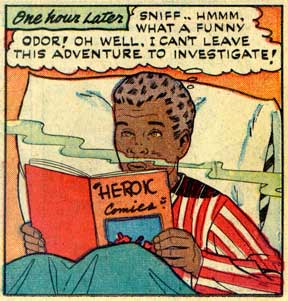
Strange, that a silly punch line from what I can only assume
to be a slightly off-color joke can accomplish so much.
Dialogue is a funny thing like that. It can do so much with
so little to evoke copious amounts of reference and inference, fleshing out
characters and settings with very little apparent heavy lifting. It is, I have
found, the culmination of the old writer’s axiom of “show, don’t tell,” even
though, when you think about it, it’s really doing a little bit of both.
One of my favorite pastimes is watching movies, and, for me,
there are really only a few things I require of my cinematic experience: good
characters (and the actors who play them), good soundtracks, quality
cinematography, a decent story that’s good enough to make me ignore any plot
holes that might be present, and, if there’s any room left in the budget for
it, engaging dialogue. (If you look carefully, you might recognize why I’m a
fan of most Steven Soderbergh or Aaron Sorkin projects.) In fact, if you can nail
the perfect dialogue in a movie, I could generally care less about what else
the movie plans on doing.
Dialogue. By itself, it’s a pretty fascinating literary device
– its history and development as a means for the conveyance of larger concepts
is fascinating. Did you know its etymology? It’s from the Greek word “dialogos”,
which literally translates to “dual meaning”, or “the two-way flow of meaning”.
That adds a nice heft to the word, don’t you think? Back in college, I had the
idea of dialogue described to me through an metaphor of painting; that the
finished product is as much a result of the eye, arm and hand of the painter as
it is the consistency of the paint, the hairs of the brush and the texture of
the canvas. In a dialogue, we have the two (or more) persons involved in the
conversation, their minds that conceive of the motivating principles that
generate the emotions behind the words, the words themselves and the ears of
the other(s) involved – lather, rinse, repeat. Essentially, what is being said
is only partially literal – a conversation tells you more about the persons
saying the words than it does anything else on its own. But, even by itself,
that is a Big Truth Worth Reading.
One of the projects I’ve been working on lately is a script,
and has resulted in one of the most fascinating studies in the power of
conversation I’ve had in a while. With only a small allowance for blocking
instructions, the rest of the writing is all conversation. Character A says
this. Character B says this. The occasional adjective for emphasis, and that’s
it. Can a story be told with only dialogue?
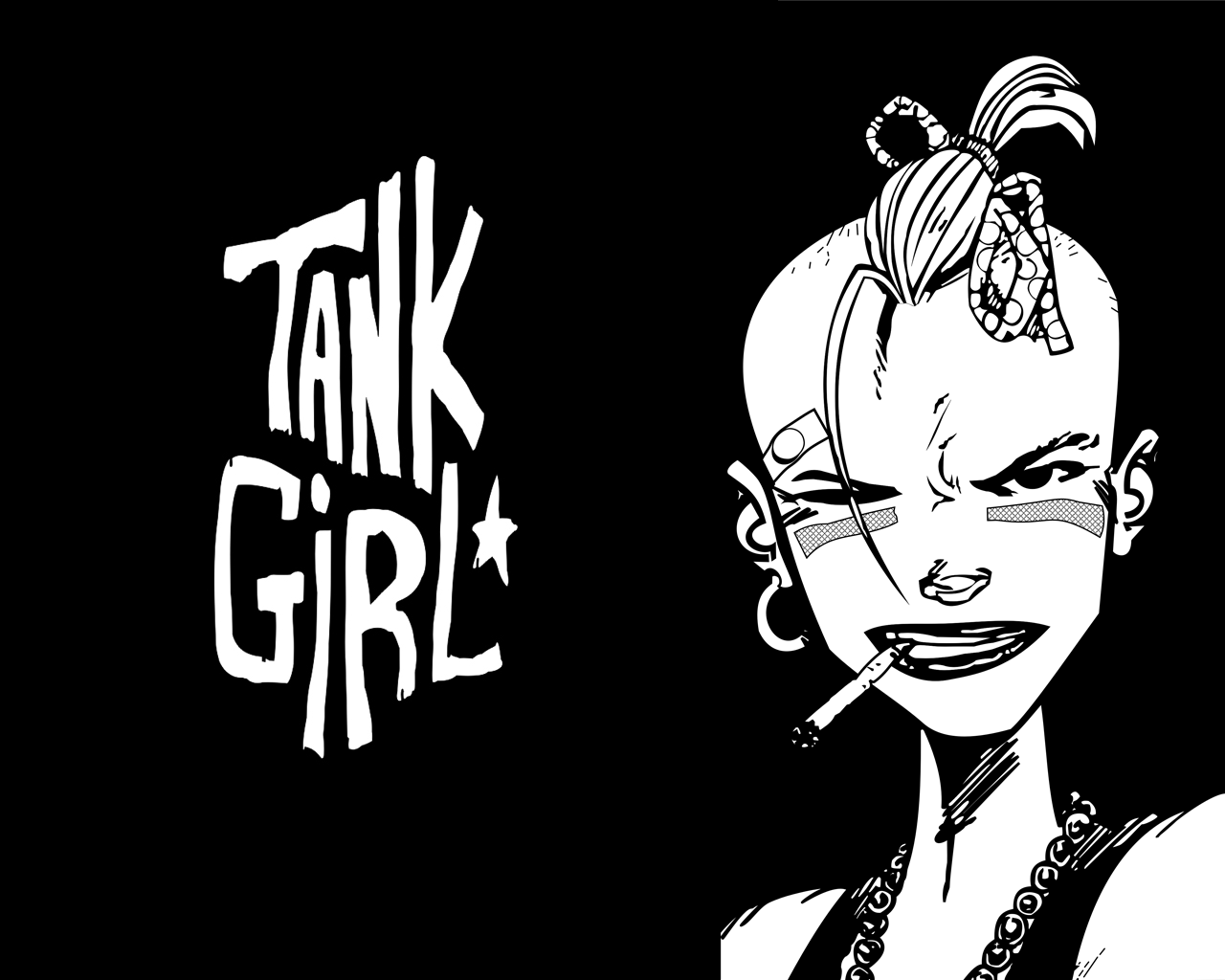
Well, in point of fact, yes. But for this to happen, the
words have to mean something. As I said before, I love movies – and at the risk
of getting Judgy Face from you, I’ll admit to a certain weakness for “comic
book adaptations”. And no, I’m not just saying “superhero movies”, I mean comic book adaptations. While this
includes the obvious films like “The Avengers” and “The Dark Knight”, it also
includes films like “Tank Girl”, “Book of Eli”, “Sin City”, and “The Walking
Dead”. Unfortunately, it also includes movies like “The Amazing Spider-man”.
The recent Spider-man movie kind of hurt my brain, much in
the way an out-of-tune piano hurts my ears.
I mean, it was so close to being a good movie, but so many little things flicked my inner child in the ear that, eventually, it just failed. Initially, it was
difficult for me to point my finger to the place where the film hurt me – the cast
was mostly brilliant, the special effects were mostly good, the music wasn’t
bad, either. The story was riddled with holes (honestly, I’m just not the sort
who’ll look for those in a movie. If I see them, you already lost me. Just for
future reference, kay?), and there were a couple moments where I very nearly stood
up and left the theater. One of these involves construction cranes, and both
involve scenes with C. Thomas Howell.

But what killed it for me was the lack of good conversation.
Now, again, for much of it I have to admit it was good, though I’d have to
credit the actors for managing to deliver pretty awkward dialogue. But the line
that shoved a pencil through my cold, black, heart was the jumbled wreck of
line delivered by Uncle Ben to a struggling and confused Peter Parker. I can’t
even now remember exactly how the line went, but I know what the line was
supposed to be. He was supposed to be telling Peter that “with great power
comes great responsibility.” That’s a wonderful line. It’s meaty and full of
promise. It weighs on you, gives you a lot to ponder. For the purposes of the
story, it’s the reverberating meaning that gives direction to a fledgling
Spider-man, and carries him through tragedy into becoming a fantastic hero,
worthy of storytelling. But rather than use that line, the writer and director
decided to NOT use the line, and cobbled together a half-hearted cheap red
haired stepbrother of a conversation, for no other conceivable reason than to
just not use the line from the book.
To me, that’s like doing a production of Hamlet and having
the titular character at one crucial moment ponder aloud, “Jeez, should I live
or die? Hmm. I don’t really have an answer to that.” It is substantive
dialogue, and its absence will be felt; like a gaping pothole directly in your
path.
At the same time, cutting out essential matter isn’t the
only way to fail. Remaining too true to the source material can also kill a
project twice dead.
The thing that some people fail to accept is that comic books
are not movies. They have teeny tiny conversational bubbles that, for the
purposes of accompanying a panel of art, serve as micro-tweets from the
characters. They’re confined to space and the writer has to bear this in mind,
trimming away the fat to ensure that the most essential matter gets through.

This becomes a clearly challenging balancing act, between
remaining true to the stories and knowing where to add and subtract to make the
stories effective, and, most importantly, knowing how the characters talk to
one another.
Joss Whedon understands this, as one recent example has
shown. Take his recent adventure, “The Avengers”, and strip away the comic book
elements – no superpowers, no gamma radiation, no space gods. Imagine the movie
being told as a gang of individuals being brought together to help a large
company be saved from a hostile corporate takeover. Think of the tone, the
dialogue, the pacing. It all still works, every last bit of it, because even
though all these characters hold unimaginably potent forces at their beck and
call, they talk like real people.
Well, they talk like really cool people. But you get my
meaning.
Whedon also succeeds in the way in which he takes
expectations and yoinks them to the side just as you get comfortable. He takes
conversational tropes and tweaks them just at the last minute, so every fast
ball becomes a curve ball and every slow ball speeds past the plate at the last
moment.
Tony Stark: “Funny things are.”

Or, in a larger context, the entire conversation between
Loki and Natasha/Black Widow. It stops being just words and turns into a slow-motion
Bruce Lee exchange of verbal parries and jabs until…well, I don’t want to give
it away, assuming you’re one of the few people alive who hasn’t yet seen the
movie.
I almost want to add a counterpoint, here, by mentioning
movies that suffered from a pronounced failure of strong dialogue and writing,
but there’s just so many. I’ll just cough and mutter under my breath that three
good examples of bad writing were prequels, and happened a long, long time ago.
Sorry, George, I have to be bold, much as it pains me.
In a perfect world, additional emphasis would be placed on
the scripting (specifically the dialogue, but they don’t have to stop there)
for future comic book adaptations. But let’s be clear, here. Any movie – any book,
any play, any written work involving dialogue of any kind – could take a strong
lesson from what makes the movie enjoyable in any lasting manner. Save a
million off the top of your special effects budget or your swollen actor pay
and invest in a strong script. Seriously. Its dividends will be monumental.
It doesn’t matter how many explosions come bursting out of
the screen, if the words coming out of the actors’ mouths isn’t similarly
well-written, all you have is eye candy.
Granted, it’s very expensive eye candy.
Jul 9, 2012
With Great Stories...
I'm a big fan of comic books. I have to use the present tense there for many reasons, not the least of which is that it's still true. I pick up about a dozen comic book titles on a monthly basis, and have been reading them almost without fail since I was about nine years old. Almost without fail is accurate, as well, because in the 1990s...well, comic books weren't exactly without fail. In point of fact, they were woefully bad.
It's easy to look back on a period of artistic development - like comic books in the 90s - and see how badly the trends thought back then to be likely to last forever truly were. But even then, I just got tired of them. It's not even that they weren't "cool" (comic books weren't even CLOSE to the realm of relative social acceptance they've since achieved) or that I'd grown out of them. They were just not very good at all. Art, marketing, stories, they just... well, they got lost a little bit.
 I picked them back up after the 90s when I came upon an independent publisher called CrossGen who was doing some impressive and unorthodox titles like Scion, Meridian, The Path, Way of the Rat, and so forth. Really imaginative and original material - it brought me right back in to the waiting arms of the comic book industry.
I watched the movie "Unbreakable", and really enjoyed it - not so much for the storyline as for the statement about how comic books were becoming the storytelling voice for our generation. And I still truly believe that.
For example, look at the motion picture industry, and its now standard approach to development. In most movies now, one of the certain stops along the moviemaking process is a little standby called storyboarding. Broken down, it's really little more than comic book design. And I think it's no mistake that this design mechanic is both attributable to comic books as much as it is creating a certain stylistic rhythm to the movies they end up becoming.
But more directly, comic books have become many movies - with many more on the way - so much so that they have begun to defy simple movie categories. Not just "action" or "science fiction", they're starting to be referred to under the title of "comic book adaptations". I recognize that this reference bristles many a critic, but where it fails to accurately define the movies' genres, it does underscore the fact that comic books truly do have a distinct storytelling style than most movies.
The Avengers is currently on track to becoming one of the highest-grossing movies of all time (as of this week, it's at number 3) - with a handful of other comic book adaptations peppered across the list: The Dark Knight, Spider-man, Iron Man 2, and so on. So it's no surprise that more and more studios are looking for ways to stake their claim on a superhero property for conversion to the silver screen. Marvel/Disney are still hoping to regain their movie rights on the X-Men titles, Spider-man and the Fantastic Four, while DC is being represented by WB and others without a centralized in-house movie production company.
This year was an unnerving one for me, being a comic book fan. This year held a lot of.... well, I want to say "promise", but I also want to say "hype." The feeling was somewhere in between the two. Essentially, we had the Avengers , The Dark Knight Rises, and The Amazing Spider-Man (yes, I know Dredd is coming out later, but I really haven't been terribly worried about that one).
I've loved the Marvel movies leading up to this, and I've always been a fan of Joss Whedon's work - he wrote my favorite spin on the X-Men comics, and though he's never had a big budget movie like this to flex his cinematic muscles, he's never failed me thus far. Christopher Nolan has done a fine job of reinventing the Batman franchise, so I remain comfortable in my anticipation of that - but Spiderman had me the most worried. You see, of all the comic book characters EVER, Spidey was always my favorite. I don't pretend to say I understand him better than his creators - I'd never presume to think I could write him, or anything.
 I'd watched the Spidey cartoons, the electric company shorts, the live action television show (don't hate. It was the 70s, and there was no tech for it), and then the Sam Raimi movies of the 2000s. I liked them all, in their own ways. Though Sony movies bent Raimi over with that third movie, I still thought his three movies were a great introduction to the Spider-man universe. Oh, sure, I had my points of criticism, but what are you going to do? It's not like they're going to make the movie as per my precise specifications, nor would I want them to.
Okay, well, maybe a little.
But here's the point I've been meaning to get to. Writing comic books is not the same as writing comic book movies. The two do NOT instantly, automatically, convert to each other's mediums. The average comic book does not simply become a movie, nor vice versa. And yes, put your torches down, there are some that have come very, very close. The Walking Dead turned into a series with huge chunks gleaned straight out of the graphic novels, for example.
And I feel for the poor wretches who decide to make comic book adaptations. There are some pretty terrifying critics out there that movie companies aren't used to having to accommodate: comic book fans. It's not like movie critics, who can always be counted upon to provide a blurb or what not. Comic book fans will often pore over the set photos and teaser trailers and insider buzz about the movies from the moment Variety announces the movie, and unleash a barrage upon the internet about their take on the films, long before the movie is even into its principle stages of development.
Sometimes, their criticism is found to be pretty valid (for example, the almost-was Wonder Woman television show, the Tim Burton/Nicolas Cage Superman movie), and other times not so much. A couple good examples of the "not so much" were the casting choice of Robert Downey Jr as Iron Man/Tony Stark, and the hiring of Joss Whedon to helm the Avengers movie. The internet suffered a mild aneurysm when those two things were announced, but look at them now: they were both pretty damn ideal.
 So, yes. The Avengers... remains perhaps one of my favorite comic book adaptations of all time. Brilliant perhaps because it was not a literal adaptation of comic books. The bulk of its story cannot be found in any one Avengers comic - in fact, most of it came from a series in Marvel's "Ultimate Universe", in the comic title of the same name, written by Mark Millar and drawn by Bryan Hitch. In fact, in that comic, they designed the character of Nick Fury to resemble Samuel L Jackson - and in one scene following the main climactic battle, they sit around contemplating the likelihood of Hollywood filming their lives, and Fury insists that only Samuel L Jackson himself should play him in the movie.
Not a bad prognostication, considering it was published in 2002.
But the part that really made the Avengers and the Dark Knight movies pay off for me as a moviegoer was that they at some point stopped being Comic Book Movies, and started being...well, movies.
I watched the new Spider-man movie this weekend, though, and clearly a lot of people still don't understand why movies like the Avengers and the Dark Knight movies worked so well, and why the Amazing Spider-man did not.
And let me be clear - almost everything about the Spider-man movie, I felt, was done right. They had an almost ideal cast (Andrew Garfield did a fabulous job, by the way. Major kudos to him.), they've got the special effects down very well, and aside from some pretty horrible continuity errors and plot holes, the movie essentially holds it own.
Where I felt it really failed, though, came down to one big thing: the script. Broken down further, it would come to the dialogue and the characterizations.
The dialogue was, to a broad point, frustratingly painful. They deliberately avoided certain key and essential dialogue in a way that I found unforgivable. One perfect example of this is the specific omission of the "with great power comes great responsibility" line. Though not originally a spoken line of dialogue in the comic, it's an integral part of his origin and his core. It's why he's Spider-man at all. In point of fact, that sentence is as key to Spider-man's universe as "To Be or Not to Be" is for Hamlet. Oh, sure, you're going to make that face at me because I just compared Spider-man to Hamlet. But you know what? They DO compare. In fact, pretty much everything in Hamlet can be found in Spider-man stories, if you want to pick nits. But my point is that there are key elements which are tied to the particular verbiage of a script, the omission of which is just ridiculous.
Seriously, what would have happened if Kenneth Branaugh had made Hamlet and left the "To Be or Not To Be" soliloquy out? You'd NEVER have forgiven him. But this is just an example - one particular Spidey-specific phrasing that is essential to the character's iconography - every bit as critical as the white eyes and the spider imagery, the cracking wise and the general rambunctiousness of the character. But there's just a certain quantity of Spidermanitude which is requisite to the character that I found strongly lacking from this movie. In a nutshell, what failed wasn't the acting or the special effects - hell, I could even live with the costume if I was forced to - but the writing and direction. Someone, somewhere, looked at that script and the story, and said, "yeah, man, we got ourselves a Spider-man movie!".
Fact is, if you strip away all the aspects of "comic book"ness, it should still make sense as a movie. And this movie wasn't that. It was a "spider-man movie", and sadly, not an even good one at that.
And on that note, I'll stop. There's only a week or so left until the Dark Knight Rises, and I don't want to depress myself further before going to watch it.
Ciao!
It's easy to look back on a period of artistic development - like comic books in the 90s - and see how badly the trends thought back then to be likely to last forever truly were. But even then, I just got tired of them. It's not even that they weren't "cool" (comic books weren't even CLOSE to the realm of relative social acceptance they've since achieved) or that I'd grown out of them. They were just not very good at all. Art, marketing, stories, they just... well, they got lost a little bit.

I watched the movie "Unbreakable", and really enjoyed it - not so much for the storyline as for the statement about how comic books were becoming the storytelling voice for our generation. And I still truly believe that.
For example, look at the motion picture industry, and its now standard approach to development. In most movies now, one of the certain stops along the moviemaking process is a little standby called storyboarding. Broken down, it's really little more than comic book design. And I think it's no mistake that this design mechanic is both attributable to comic books as much as it is creating a certain stylistic rhythm to the movies they end up becoming.
But more directly, comic books have become many movies - with many more on the way - so much so that they have begun to defy simple movie categories. Not just "action" or "science fiction", they're starting to be referred to under the title of "comic book adaptations". I recognize that this reference bristles many a critic, but where it fails to accurately define the movies' genres, it does underscore the fact that comic books truly do have a distinct storytelling style than most movies.
The Avengers is currently on track to becoming one of the highest-grossing movies of all time (as of this week, it's at number 3) - with a handful of other comic book adaptations peppered across the list: The Dark Knight, Spider-man, Iron Man 2, and so on. So it's no surprise that more and more studios are looking for ways to stake their claim on a superhero property for conversion to the silver screen. Marvel/Disney are still hoping to regain their movie rights on the X-Men titles, Spider-man and the Fantastic Four, while DC is being represented by WB and others without a centralized in-house movie production company.
This year was an unnerving one for me, being a comic book fan. This year held a lot of.... well, I want to say "promise", but I also want to say "hype." The feeling was somewhere in between the two. Essentially, we had the Avengers , The Dark Knight Rises, and The Amazing Spider-Man (yes, I know Dredd is coming out later, but I really haven't been terribly worried about that one).
I've loved the Marvel movies leading up to this, and I've always been a fan of Joss Whedon's work - he wrote my favorite spin on the X-Men comics, and though he's never had a big budget movie like this to flex his cinematic muscles, he's never failed me thus far. Christopher Nolan has done a fine job of reinventing the Batman franchise, so I remain comfortable in my anticipation of that - but Spiderman had me the most worried. You see, of all the comic book characters EVER, Spidey was always my favorite. I don't pretend to say I understand him better than his creators - I'd never presume to think I could write him, or anything.
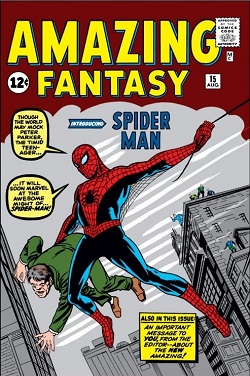
Okay, well, maybe a little.
But here's the point I've been meaning to get to. Writing comic books is not the same as writing comic book movies. The two do NOT instantly, automatically, convert to each other's mediums. The average comic book does not simply become a movie, nor vice versa. And yes, put your torches down, there are some that have come very, very close. The Walking Dead turned into a series with huge chunks gleaned straight out of the graphic novels, for example.
And I feel for the poor wretches who decide to make comic book adaptations. There are some pretty terrifying critics out there that movie companies aren't used to having to accommodate: comic book fans. It's not like movie critics, who can always be counted upon to provide a blurb or what not. Comic book fans will often pore over the set photos and teaser trailers and insider buzz about the movies from the moment Variety announces the movie, and unleash a barrage upon the internet about their take on the films, long before the movie is even into its principle stages of development.
Sometimes, their criticism is found to be pretty valid (for example, the almost-was Wonder Woman television show, the Tim Burton/Nicolas Cage Superman movie), and other times not so much. A couple good examples of the "not so much" were the casting choice of Robert Downey Jr as Iron Man/Tony Stark, and the hiring of Joss Whedon to helm the Avengers movie. The internet suffered a mild aneurysm when those two things were announced, but look at them now: they were both pretty damn ideal.

Not a bad prognostication, considering it was published in 2002.
But the part that really made the Avengers and the Dark Knight movies pay off for me as a moviegoer was that they at some point stopped being Comic Book Movies, and started being...well, movies.
I watched the new Spider-man movie this weekend, though, and clearly a lot of people still don't understand why movies like the Avengers and the Dark Knight movies worked so well, and why the Amazing Spider-man did not.
And let me be clear - almost everything about the Spider-man movie, I felt, was done right. They had an almost ideal cast (Andrew Garfield did a fabulous job, by the way. Major kudos to him.), they've got the special effects down very well, and aside from some pretty horrible continuity errors and plot holes, the movie essentially holds it own.
Where I felt it really failed, though, came down to one big thing: the script. Broken down further, it would come to the dialogue and the characterizations.
The dialogue was, to a broad point, frustratingly painful. They deliberately avoided certain key and essential dialogue in a way that I found unforgivable. One perfect example of this is the specific omission of the "with great power comes great responsibility" line. Though not originally a spoken line of dialogue in the comic, it's an integral part of his origin and his core. It's why he's Spider-man at all. In point of fact, that sentence is as key to Spider-man's universe as "To Be or Not to Be" is for Hamlet. Oh, sure, you're going to make that face at me because I just compared Spider-man to Hamlet. But you know what? They DO compare. In fact, pretty much everything in Hamlet can be found in Spider-man stories, if you want to pick nits. But my point is that there are key elements which are tied to the particular verbiage of a script, the omission of which is just ridiculous.
Seriously, what would have happened if Kenneth Branaugh had made Hamlet and left the "To Be or Not To Be" soliloquy out? You'd NEVER have forgiven him. But this is just an example - one particular Spidey-specific phrasing that is essential to the character's iconography - every bit as critical as the white eyes and the spider imagery, the cracking wise and the general rambunctiousness of the character. But there's just a certain quantity of Spidermanitude which is requisite to the character that I found strongly lacking from this movie. In a nutshell, what failed wasn't the acting or the special effects - hell, I could even live with the costume if I was forced to - but the writing and direction. Someone, somewhere, looked at that script and the story, and said, "yeah, man, we got ourselves a Spider-man movie!".
Fact is, if you strip away all the aspects of "comic book"ness, it should still make sense as a movie. And this movie wasn't that. It was a "spider-man movie", and sadly, not an even good one at that.
And on that note, I'll stop. There's only a week or so left until the Dark Knight Rises, and I don't want to depress myself further before going to watch it.
Ciao!
Jun 14, 2012
In Which We Attempt to Pay the Bills
I don't like flooding my twitter stream with the deets - plus, come on, 140 characters can't do everything - so I wanted to update you with some of the basics of my current books:
The main series - completed, "in the can", and available for your hungry reading-holes, is titled The Chronicles of Aesirium. Though labeled as science fiction/fantasy, it's got a funny little delicious aftertaste that you might not recognize, but is called "Steampunk." But the books are at their heart about a young orphan girl named Romany ("Rom" to her friends) who finds that not only are the Reapers real - those terrifying beings that are said to steal away the souls of the unwary as they fly above the rooftops of Oldtown-Against-the-Wall - but that she is one of them!
Described as "a Victorian Buffy the Vampire Slayer", and "Death, wearing a pretty black dress", the Aesirium books take you through the streets of Oldtown, over the eponymous Wall and into Aesirium itself, discovering - and answering - the riddles that plague the people who live there. These same riddles that had divided their city, and are tied to the many threats of their past and future.
It's available in individual volumes on Amazon both as ebooks for the Kindle and in paperback formats, and in bundles at Barnes and Noble for the Nook.
The next series is my "Into the Dust" series, a prequel of sorts to an upcoming novel that retells the story of Peter Pan as a contemporary fantasy horror story. I wrote these with the fantastic author Kiri Callaghan, with whom I am completely blessed to be friends.
We compiled the entire series of stories into "the collection", and even added a bonus story. Who says we don't know how to drive a bargain?
The individual stories of "Into the Dust" are available only for the kindle; the collection is available as a Kindle ebook and as a paperback.
Then, and in a wholly literary divergent direction, I've also done a sort of compilation of blogs and musings about growing up and finding myself to be an adult geek in Dad form. I called these compilations "The Middle Age: A geek's journey from boy to man". These are available as kindle books, as well.
Also, I participated with my creative cohorts at Talaria Press to produce "Quests and Answers" - 7 great tales of....well, Quests and Answers. Duh! This is available as an eBook and also as a paperback.
Okay, so that's the bulk of my publishing materials thus far. What's next?
Well, I'm working with Talaria Press on the NEXT anthology, which is going to be quite delightful and a bit more fun. One of the stories I'm doing for that is about a character that will be appearing in my next series, which I'm already writing and will be called "The Old Bones." I don't want to give too much away, but suffice it to say that it's going to be a fully contemporary series, so I'll get to make all those jokes about Star Wars and Starbucks I've been just dying to make all this time.
Also, Kiri and I will be working together again, this time to do the full "Dust" book that our original project was designed to introduce. If the wind stays at my back, both these novels should be completed by the fall - but I'll be releasing additional smaller projects along the way, count on it!
If you've picked up (or decide now to pick up) any of the above titles, please let me know - I'd love to hear what you think! And reviews on Amazon are, of course, ALWAYS appreciated!
Thanks for reading!
Allons-y!
 |
| Rom, sketched by Joe Benitez |
Described as "a Victorian Buffy the Vampire Slayer", and "Death, wearing a pretty black dress", the Aesirium books take you through the streets of Oldtown, over the eponymous Wall and into Aesirium itself, discovering - and answering - the riddles that plague the people who live there. These same riddles that had divided their city, and are tied to the many threats of their past and future.
It's available in individual volumes on Amazon both as ebooks for the Kindle and in paperback formats, and in bundles at Barnes and Noble for the Nook.
The next series is my "Into the Dust" series, a prequel of sorts to an upcoming novel that retells the story of Peter Pan as a contemporary fantasy horror story. I wrote these with the fantastic author Kiri Callaghan, with whom I am completely blessed to be friends.
We compiled the entire series of stories into "the collection", and even added a bonus story. Who says we don't know how to drive a bargain?
The individual stories of "Into the Dust" are available only for the kindle; the collection is available as a Kindle ebook and as a paperback.
Then, and in a wholly literary divergent direction, I've also done a sort of compilation of blogs and musings about growing up and finding myself to be an adult geek in Dad form. I called these compilations "The Middle Age: A geek's journey from boy to man". These are available as kindle books, as well.
Also, I participated with my creative cohorts at Talaria Press to produce "Quests and Answers" - 7 great tales of....well, Quests and Answers. Duh! This is available as an eBook and also as a paperback.
Okay, so that's the bulk of my publishing materials thus far. What's next?
Well, I'm working with Talaria Press on the NEXT anthology, which is going to be quite delightful and a bit more fun. One of the stories I'm doing for that is about a character that will be appearing in my next series, which I'm already writing and will be called "The Old Bones." I don't want to give too much away, but suffice it to say that it's going to be a fully contemporary series, so I'll get to make all those jokes about Star Wars and Starbucks I've been just dying to make all this time.
Also, Kiri and I will be working together again, this time to do the full "Dust" book that our original project was designed to introduce. If the wind stays at my back, both these novels should be completed by the fall - but I'll be releasing additional smaller projects along the way, count on it!
If you've picked up (or decide now to pick up) any of the above titles, please let me know - I'd love to hear what you think! And reviews on Amazon are, of course, ALWAYS appreciated!
Thanks for reading!
Allons-y!
Jun 7, 2012
The Wild West
A few years ago, my day job was pretty much your stereotypical technical support position. Taking calls, answering questions, helping internal customers (also known as "employees"), and fixing computer problems. Oh, and there's also the re-routing of about a dozen or more calls a day who were sent to the wrong department, but, eh. But beside the occasional and frequently aggressive hysterics that IT support persons have to experience, the element that was the most difficult for me was the part of just being at work by 4 am, 5 days a week. I'm not really a morning person - well, I am, provided that I can spend my morning sleeping. But, being at my desk, logged into the phones and my desktop computer, ready to process another bundle of technical nightmares....well, some days there just wasn't enough coffee in the world.
On several occasions, I would simply find myself sitting at my desk, without clear recollection of having gotten up, dressed, and driven to work. And yet there I sat, pants (thank god), shoes, socks, shirt, and so forth. Those days were a little unsettling. I mean, I clearly had driven there (though finding your car in the parking lot when you have completely forgotten where or how you'd parked it can be a bit of a challenge), but I'd obviously been pretty half-asleep along the way. Yikes, right?
I was reminded of this the other day when a friend of mine and I were talking about the progress I've made in writing over the past couple of years. Though, granted, it's still evolving, things are a fair sight more established and blossoming than they were even a year ago. But it occurred to me that I've come a long ways and hadn't really pondered how I'd gotten here. I've been asked by a lot of "aspiring writers" (and please, for the love of god, you've really got to avoid ever saying that about yourself, trust me.) what the secret is - both to getting projects done and to getting attention as a writer. And to be honest, I struggle with settling on any one answer to that question.
I don't think this is a bad thing.
 Another author friend of mine compared the current period of DIY-ism that can be seen in music, writing, film and even industries previously believed to be safely in the hands of big business like video games, to the Wild West and the time of the Gold Rush. Just look at the frenzy - everyone with two metal pans to rub together has a chance to strike it rich, even though in the end only a few will strike true paydirt. I've seen a few people compare self-publishing to the lottery - many people play, and almost nobody wins. You want to be rich? "Then, play by the rules, and get in line like everybody else. Maybe you'll get lucky."
Publishing is turning out to be less like the lottery, however, and more like the gold rush. The numbers seem to back this up - although some of the larger publishers and chain bookstores have been claiming a drop in numbers, when you factor in all the various ebook and POD suppliers, book sales are actually higher than they were, say, 4 or 5 years ago back before the technology of ebooks, internet marketplaces and self-publishing (as opposed to Vanity Press companies) really got a head of steam going.
Until this time, it was very challenging for a new author to get published, but over the years a very particular path has been laid out for them: write; get short stories published; work hard; get recognition; prove yourself; find an agent; get published. A simple enough path made all the more complex by the sheer quantities of competition.Thousands of unpublished manuscripts are read and denied every week at each level of the publishing industry: agents, editors, publishers. The US alone has enough unpublished authors to fill a mid-sized American city, and only enough agents, editors and publishers to fill a football stadium. Those aren't good odds, are they? And with so many layoffs in these same publishing houses, the ratio of author:publishing contact is only getting worse. So what happens to these unprocessed, unpublished manuscripts? If you ask the proponents of conventional wisdom, the answer boils down to "if it's good enough, it'll get published. Just keep trying." This is a silly distillation, and, also, complete bullshit.
It is, however, the quickest way they can think of to clear off their desks and get people to stop emailing them.
Let me clarify something here. I've submitted a couple of my own books into the Query mill, and in spite of really positive responses, they all ended up saying roughly the same thing - discarding the dozen or so "thank you but no thank you" form emails their own time constraints require of them. Only a few agents didn't even respond at all, but I hold no ill will towards them, either. In fact, to all the agents, editors and publishers who've told me "no thanks", I'm not mad at them. Seriously. I'm not even upset at the process. It's unfortunate, but it's the best we've had for years at trying to process the thousands and thousands of manuscripts all yearning for publication.
The common answer I received, by the way, was NOT a form email. Several agents and I talked at length about my books, and they always really liked the books, but just didn't know how to market them. The characters, the world, the history - they loved them all. But how do you market a young adult science fiction fantasy adventure with a hint of steampunk and a subtext of cultural revolution, housed in an alternate history dystopian civilization? Last time I checked, Barnes and Noble didn't have a shelf for that.
And let's be honest: when it comes to the present state of the "traditional publishing" industry, it's all about fast returns and the price of real estate. I get that, I do. It's about crunching numbers and determining investment over ROI, and figuring out what it will take to bump your company's shares up a point. It's about making your quarterly goals and lifting the overall value of the company. But for me....well, I can either consider myself a chunk of grist to be cast into the mill and cross my fingers for that perfect combination of agent/publisher that will see the inherent value or potentiality of me or my books.... or I can go out and make it happen on my own terms.
One of the really interesting things I've noted along the way is the general wailing and gnashing of teeth from people who hold to the "traditional" route. Oh, they sound angry! But honestly, I can look past their general disdain couched within their "friendly advice" to see what is going on. They're justifiably nervous about the changes to an industry they previously enjoyed in a quite solitary capacity. Where once there had been relatively few truly successful publishing houses, suddenly there was an explosion of business popping up at every turn. All the rules of publishing genre were smashed. People were coming out with digital books for a fraction of the price of their paperback counterparts - and bypassing hardcover books entirely! And what's worse, so many of these "publishers" were the authors themselves, making 35-70% or more on every unit they sold! Good god almighty! It's the end of the world, they'd cry, rending their garments and coating themselves in ash and sackcloth. Or, like we now know it, snark and condescension. (I really wanted to include links here to a few of the big offenders, but I won't. They have their opinions, and I have mine. In the end, does it even matter if either one of us is correct? History would tell us we're probably both wrong.)
Change can be a little scary, sure. But I'm not here to either bury or praise Caesar. I'm here to tell you why I think that it doesn't have to be an "either or" situation. This is not Thunderdome.
Amazon - just like so many successful franchises - started with the notion of finding a new way to do the old things. It looked at the internet and saw that it was a virtually untapped hemisphere of marketing potential which gloriously catered to the forward-thinking and geek-centric. It addressed people's inclinations towards getting things now, to liking to shop but not to mingle - it offered a service in a way Amazon supposed would not immediately catch fire, but, in time, would.
 People didn't always feel they needed to call out for pizza. One hundred years ago, did people look at their phones and say "gosh, if only I could pick up this infernal contraption, and place a call so that a fresh hot pizza would arrive here within 30 minutes or less?" No, not really, no. but someone thought so. In 1960, Domino's started up, and here we are more than 50 years later and it's everywhere. I was in Mexico City when two of its first franchises in the country opened - I know this because I knew one of the managers - and they did more business in their FIRST MONTH than any other Domino's store in the entire world. Just like Ewan MacGregor's character said in "Robots": find a need, fill a need.
And they weren't alone - there were other companies (with new ones popping up every day) who tried to jump into the maelstrom of internet entrepreneurship, only to be dashed against the Scylla or Charybdis along the way. One might say our entire national culture has derived from an almost Darwinian practice of letting the victor have all the spoils. But in the end, Amazon remained as the essentially undisputed champion of internet bookstores.
That's when they did something really weird. They reached out to authors who weren't getting published in the old standard way, and gave them the chance to get published, on their own merits. In the truest example of corporate-sponsored capitalism, everyone who writes gets a chance to be read. Amazon reportedly now has millions of self-published books, both in ebook and paperback format, created, developed and priced by the authors. Successful authors can even be picked up by the larger publishing houses, after an author finds a level of success on their own. Or even successful authors can opt to work with Amazon to publish all their work, including the backlist of their work, long since abandoned by the publishing houses.
Marketing and genre-bending opportunities are everywhere, now. An author need not shove their work into a marketable genre, just on the hopes of getting fitted into the shelves. They can write their story as the story demands, and then use keywords to help direct shoppers to their work.
 There's that wonderful scene in Star Trek 2, where the crew of the Enterprise and Khan are playing a lethal game of hide-and-seek inside a sensor-blinding nebula. They out-maneuver Khan, who, unused to the challenges and opportunities of deep space tactics, does not think of looking up or down for the clever Federation. It's a bit of a limiting parable, but one I think very much applies to so many of these companies that are unable or unwilling to access the parts of their mind which might allow for new and exciting revenue streams or the monetization of the internet.
To them, I want to say "snap out of it, you gol-darned idjit! There's gold in them thar hills!"
And to the rest of you, readers and writers alike - I say thank you for embracing the world of the new, and for wandering with me through these exciting lands of adventure and suspense. What will tomorrow bring? Honestly, we don't know. None of us do. There's no magic bullet, no prophetic prognosticator capable of knowing exactly what's going to work and what's going to happen and what won't.
What I do know is that the future we make, we're going to make together.
More to follow.
Is that worth demonizing?
On several occasions, I would simply find myself sitting at my desk, without clear recollection of having gotten up, dressed, and driven to work. And yet there I sat, pants (thank god), shoes, socks, shirt, and so forth. Those days were a little unsettling. I mean, I clearly had driven there (though finding your car in the parking lot when you have completely forgotten where or how you'd parked it can be a bit of a challenge), but I'd obviously been pretty half-asleep along the way. Yikes, right?
I was reminded of this the other day when a friend of mine and I were talking about the progress I've made in writing over the past couple of years. Though, granted, it's still evolving, things are a fair sight more established and blossoming than they were even a year ago. But it occurred to me that I've come a long ways and hadn't really pondered how I'd gotten here. I've been asked by a lot of "aspiring writers" (and please, for the love of god, you've really got to avoid ever saying that about yourself, trust me.) what the secret is - both to getting projects done and to getting attention as a writer. And to be honest, I struggle with settling on any one answer to that question.
I don't think this is a bad thing.
Publishing is turning out to be less like the lottery, however, and more like the gold rush. The numbers seem to back this up - although some of the larger publishers and chain bookstores have been claiming a drop in numbers, when you factor in all the various ebook and POD suppliers, book sales are actually higher than they were, say, 4 or 5 years ago back before the technology of ebooks, internet marketplaces and self-publishing (as opposed to Vanity Press companies) really got a head of steam going.
Until this time, it was very challenging for a new author to get published, but over the years a very particular path has been laid out for them: write; get short stories published; work hard; get recognition; prove yourself; find an agent; get published. A simple enough path made all the more complex by the sheer quantities of competition.Thousands of unpublished manuscripts are read and denied every week at each level of the publishing industry: agents, editors, publishers. The US alone has enough unpublished authors to fill a mid-sized American city, and only enough agents, editors and publishers to fill a football stadium. Those aren't good odds, are they? And with so many layoffs in these same publishing houses, the ratio of author:publishing contact is only getting worse. So what happens to these unprocessed, unpublished manuscripts? If you ask the proponents of conventional wisdom, the answer boils down to "if it's good enough, it'll get published. Just keep trying." This is a silly distillation, and, also, complete bullshit.
It is, however, the quickest way they can think of to clear off their desks and get people to stop emailing them.
Let me clarify something here. I've submitted a couple of my own books into the Query mill, and in spite of really positive responses, they all ended up saying roughly the same thing - discarding the dozen or so "thank you but no thank you" form emails their own time constraints require of them. Only a few agents didn't even respond at all, but I hold no ill will towards them, either. In fact, to all the agents, editors and publishers who've told me "no thanks", I'm not mad at them. Seriously. I'm not even upset at the process. It's unfortunate, but it's the best we've had for years at trying to process the thousands and thousands of manuscripts all yearning for publication.
The common answer I received, by the way, was NOT a form email. Several agents and I talked at length about my books, and they always really liked the books, but just didn't know how to market them. The characters, the world, the history - they loved them all. But how do you market a young adult science fiction fantasy adventure with a hint of steampunk and a subtext of cultural revolution, housed in an alternate history dystopian civilization? Last time I checked, Barnes and Noble didn't have a shelf for that.
And let's be honest: when it comes to the present state of the "traditional publishing" industry, it's all about fast returns and the price of real estate. I get that, I do. It's about crunching numbers and determining investment over ROI, and figuring out what it will take to bump your company's shares up a point. It's about making your quarterly goals and lifting the overall value of the company. But for me....well, I can either consider myself a chunk of grist to be cast into the mill and cross my fingers for that perfect combination of agent/publisher that will see the inherent value or potentiality of me or my books.... or I can go out and make it happen on my own terms.
One of the really interesting things I've noted along the way is the general wailing and gnashing of teeth from people who hold to the "traditional" route. Oh, they sound angry! But honestly, I can look past their general disdain couched within their "friendly advice" to see what is going on. They're justifiably nervous about the changes to an industry they previously enjoyed in a quite solitary capacity. Where once there had been relatively few truly successful publishing houses, suddenly there was an explosion of business popping up at every turn. All the rules of publishing genre were smashed. People were coming out with digital books for a fraction of the price of their paperback counterparts - and bypassing hardcover books entirely! And what's worse, so many of these "publishers" were the authors themselves, making 35-70% or more on every unit they sold! Good god almighty! It's the end of the world, they'd cry, rending their garments and coating themselves in ash and sackcloth. Or, like we now know it, snark and condescension. (I really wanted to include links here to a few of the big offenders, but I won't. They have their opinions, and I have mine. In the end, does it even matter if either one of us is correct? History would tell us we're probably both wrong.)
Change can be a little scary, sure. But I'm not here to either bury or praise Caesar. I'm here to tell you why I think that it doesn't have to be an "either or" situation. This is not Thunderdome.
Amazon - just like so many successful franchises - started with the notion of finding a new way to do the old things. It looked at the internet and saw that it was a virtually untapped hemisphere of marketing potential which gloriously catered to the forward-thinking and geek-centric. It addressed people's inclinations towards getting things now, to liking to shop but not to mingle - it offered a service in a way Amazon supposed would not immediately catch fire, but, in time, would.
And they weren't alone - there were other companies (with new ones popping up every day) who tried to jump into the maelstrom of internet entrepreneurship, only to be dashed against the Scylla or Charybdis along the way. One might say our entire national culture has derived from an almost Darwinian practice of letting the victor have all the spoils. But in the end, Amazon remained as the essentially undisputed champion of internet bookstores.
That's when they did something really weird. They reached out to authors who weren't getting published in the old standard way, and gave them the chance to get published, on their own merits. In the truest example of corporate-sponsored capitalism, everyone who writes gets a chance to be read. Amazon reportedly now has millions of self-published books, both in ebook and paperback format, created, developed and priced by the authors. Successful authors can even be picked up by the larger publishing houses, after an author finds a level of success on their own. Or even successful authors can opt to work with Amazon to publish all their work, including the backlist of their work, long since abandoned by the publishing houses.
Marketing and genre-bending opportunities are everywhere, now. An author need not shove their work into a marketable genre, just on the hopes of getting fitted into the shelves. They can write their story as the story demands, and then use keywords to help direct shoppers to their work.
To them, I want to say "snap out of it, you gol-darned idjit! There's gold in them thar hills!"
And to the rest of you, readers and writers alike - I say thank you for embracing the world of the new, and for wandering with me through these exciting lands of adventure and suspense. What will tomorrow bring? Honestly, we don't know. None of us do. There's no magic bullet, no prophetic prognosticator capable of knowing exactly what's going to work and what's going to happen and what won't.
What I do know is that the future we make, we're going to make together.
More to follow.
Is that worth demonizing?
Jun 4, 2012
Steampunk Tales, now on the Nook!
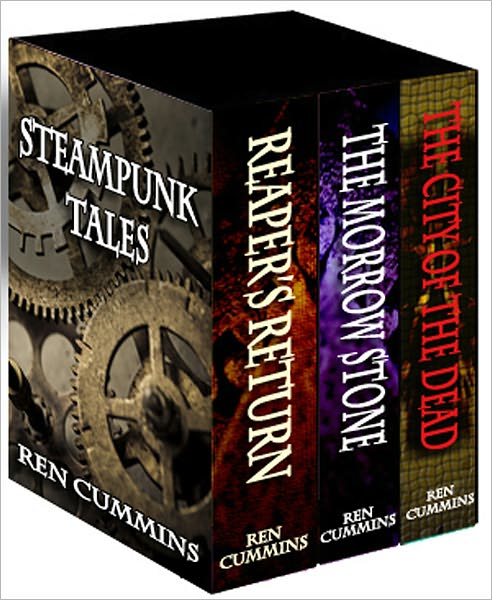 I've been a pretty big fan of the Amazon kindle experience so far - had a couple of issues with the Barnes and Noble process, mostly of a technical nature. But at this year's Emerald City Comic Con, a lot of readers asked me to offer up a Nook version of my books. Well, rather than go through and individually publish all six of them, I'm doing you one better.
Now, the first three are available as a set. Yes. At the risk of putting on my late night infomercial voice (don't make me, I'll do it, I swear!), you get three novels in one bundle. Three.
It's already gone live on Barnes and Noble's website here and it looks very sad and lonely without a few reviews. Please let me know if you have a Nook and would like to read and review them for the B&N site. First five people to volunteer will get a free copy of the Nook version.
No, I'm not bribing people - - I'm just saying if you are willing to take the time to read and write a review, then the least I can do is not make you pay for the book in the first place.
So either let me know in the comments section, or drop me an email at ren at renwritings dot com and I'll hook the first five folks up!
May 25, 2012
Artist's Statement
A good and extremely wise friend of mine and I were talking the other day about Artist's Statements. And when I say we were talking about them, what I really mean is that she mentioned it and I realized that I've never actually written anything like that. Struck me as a really good idea, it did.
Bit of conversational backstory: been feeling a bit restless, creatively, since the last of the Chronicles of Aesirium books came out, back in December of last year. Those six books summarized a fair bulk of my creative work over the past two years, and it left me a bit stretched out and feeling vacant. And it wasn't that I had no other ideas to write about - I've already completed a few other projects and have many others in various stages of development. But it almost felt like I was in between relationships - a softer sense of mourning, I guess.
I haven't really felt the urgent sense of work work work because oh my god it must be done like I'd felt previously, and that lacking had nothing to do with a diminished sense of desire nor any sort of writer's block. It wasn't a becalming, it...well, I had more explanations describing that which is was not than I had for what it was.
I've been tracking book sales - this has become a year wherein I actually have to start tracking them, the fact of which generates in me a good deal more gratitude than I'm presently expressing - but as it turns out I'm really not in this for the money. And to that I say, excellent! So if modest returns don't fill me with a sense of deepened satisfaction, what will?
That was the question which not only gave me pause, but the pausing itself filled me with a renewed sense of purpose. Why do I write? "Because I must".... isn't enough. It was enough, ten years ago. It's not, now.
So here I am. And here is my artist's statement.
Bit of conversational backstory: been feeling a bit restless, creatively, since the last of the Chronicles of Aesirium books came out, back in December of last year. Those six books summarized a fair bulk of my creative work over the past two years, and it left me a bit stretched out and feeling vacant. And it wasn't that I had no other ideas to write about - I've already completed a few other projects and have many others in various stages of development. But it almost felt like I was in between relationships - a softer sense of mourning, I guess.
I haven't really felt the urgent sense of work work work because oh my god it must be done like I'd felt previously, and that lacking had nothing to do with a diminished sense of desire nor any sort of writer's block. It wasn't a becalming, it...well, I had more explanations describing that which is was not than I had for what it was.
I've been tracking book sales - this has become a year wherein I actually have to start tracking them, the fact of which generates in me a good deal more gratitude than I'm presently expressing - but as it turns out I'm really not in this for the money. And to that I say, excellent! So if modest returns don't fill me with a sense of deepened satisfaction, what will?
That was the question which not only gave me pause, but the pausing itself filled me with a renewed sense of purpose. Why do I write? "Because I must".... isn't enough. It was enough, ten years ago. It's not, now.
So here I am. And here is my artist's statement.
The moon is a funny thing. She just floats out there in the sky above us, reflecting the powerful sunlight which marks our days and nights. My eyes have always seemed to find her there, and though I claim neither lunacy nor lycanthropy, I've felt a certain kinship to her waxings and wanings. As a boy, I'd often look up and recognize that a million other eyes were likely watching her as well at that very moment, and it made me feel connected to them all in that instant. The big planet of ours seemed just a little smaller - an odd thing for so distant an object to generate a sensation of such closeness.
I was raised by the seemingly incompatible cultures of religion and pop culture - putting as much faith in the Force as I did in God. And though my faith has changed many times in the course of my life, it now feels far more like a pilgrim's journey than anything - and that journey, both in execution and evaluation, has always sought conveyance; usually as a metaphor in some manner. Also, quite often, with a little bit of funny thrown in for good measure.
As I grew, that lingering sensibility remained - with pictures, with music, and, eventually, with words, each finding in me a love for their crafts and their ability to create that same associative approximation as the moon. The gentle lines of a soft pencil upon canvas, the melodic refrain floating from a piano, or a tale of adventure or love's redemption...I often can't tell if I'm the pianist, the piano or the melody. And that's okay.
I feel a kinship to the bardic tradition, of storytelling and passing along the myths and legends to the following generation - of reaching up towards the stars and weaving them into constellations. And also, to borrow from George Bernard Shaw, I love to dream of worlds which have never been - but quite possibly could - asking, "Why not?"
And then, you know, write about them.
Subscribe to:
Posts (Atom)